Best Grocery Budget App for Families (2026)
Families overspend on groceries because multiple people shop without coordination. Here's how to fix that with per-cart budgets, templates, and shared lists.
Key Takeaways
• Family grocery overspending is a coordination problem, not a willpower problem.
• Per-cart budgets and Family Sharing let everyone shop against the same limit.
• Templates eliminate the weekly 'what do we need?' rebuild from scratch.
• Most list apps solve what to buy but ignore how much you're spending.
Track your grocery spending as you shop
Free to use. Works offline, no account needed.


The average family of four spends over $1,000 a month on groceries. The problem isn't usually that one person overspends — it's that three people shop independently throughout the week, nobody knows what's already been bought, and nobody's tracking the running total.
Family grocery overspending is a coordination problem. And most apps treat it as either a list problem or a whole-household-budget problem. Neither is the right fit.
Why Generic Solutions Don't Work for Families
YNAB and budgeting apps: YNAB costs $14.99/mo and manages your entire financial life. It tracks your monthly grocery category, but it doesn't know who bought what, can't track prices in real time, and doesn't help at the store. It's overkill if groceries are the main issue, and it requires everyone in the family to learn a complex budgeting methodology. See our full YNAB comparison.
Bring! and shared list apps: Bring! makes beautiful shared lists. The whole family can see what needs to be bought and check things off. But there's zero budget awareness — no prices, no running total, no spending limit. You coordinate what to buy but not how much you're spending. See our Bring! comparison.
AnyList: Good list management and recipe features. No budget tracking, no price memory, no spending insights. The sharing feature requires a paid subscription. See our AnyList comparison.
The gap is clear: families need shared lists with budget tracking built in.
How GroceryBudget Handles Family Shopping
We built GroceryBudget around the idea that grocery budgeting happens per trip, not per month. Here's how that works for families:
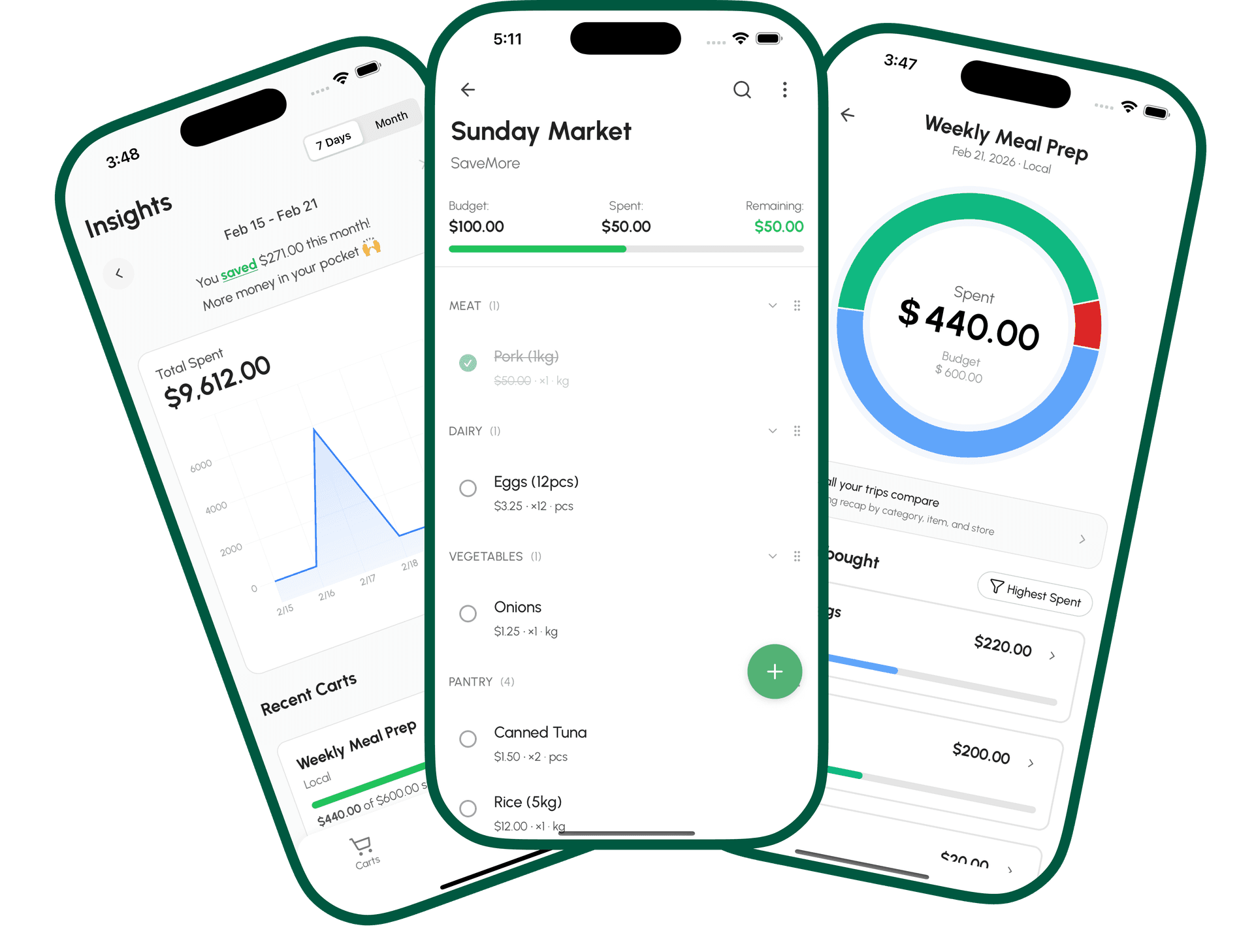
Per-cart budgets. Each shopping trip gets its own budget. The Saturday Costco run has a $200 budget. The Tuesday top-up at the local store has a $40 budget. Everyone sees the same budget bar filling up in real time.
Family Sharing (Premium). Multiple family members can access the same carts. When your partner adds items at one store, you see the budget update on your phone. No more "I didn't know you already bought chicken."
Templates. Save your weekly shopping list as a template with pre-filled items and prices. Start each week's cart from the template instead of rebuilding from scratch. Families tend to buy roughly the same things — templates reflect that.
Price memory. The app remembers what you paid for every item at every store. When someone adds "milk" to the cart, it suggests the price from last time. No more guessing or forgetting to enter prices.
Real-time budget alerts. The budget bar shows exactly where you stand. When you're approaching the limit, you know before you hit the register — not after.
Stop guessing what your groceries cost
Free to use. Works offline, no account needed.
How Families Actually Compare
| Feature | YNAB | Bring! | AnyList | GroceryBudget |
|---|---|---|---|---|
| Shared shopping lists | No | Yes | Yes (paid) | Yes (Premium) |
| Per-trip budget | No | No | No | Yes |
| Real-time spending total | No | No | No | Yes |
| Price memory | No | No | No | Yes |
| Item-level insights | No | No | No | Yes |
| Store comparison | No | No | No | Yes (Premium) |
| Templates | No | No | Yes | Yes |
| Offline support | No | Yes | Yes | Yes |
| No account to start | No | No | No | Yes |
| Cost | $14.99/mo | Free (ads) | Free / $12.99/yr | Free / $4.99/mo |
Who Should Use GroceryBudget for Family Shopping
This is a good fit if:
- Multiple people in your household do grocery shopping
- You consistently go over your weekly or monthly grocery budget
- You want everyone to see a shared budget, not just a shared list
- You want to track where your grocery money actually goes over time
- You shop at multiple stores and want to compare prices
This is not the right fit if:
- Nobody in your household cares about budget tracking — you just want a shared checklist
- Recipe integration and meal planning are your primary feature (AnyList is better for that)
- You want to manage your entire household finances in one tool (YNAB does that)
Getting Started as a Family
Start with one person creating a cart with a budget. Add your usual items — price memory will build up after the first trip. After a couple of trips, save a template.
Then upgrade to Premium to turn on Family Sharing. Add your partner or family members so everyone shops from the same carts with the same budgets.
After a few weeks, check Insights to see where the money is actually going. Most families find one or two categories (snacks, drinks, impulse buys) eating a disproportionate share of the budget. That's where the savings are.
The Bottom Line
Family grocery overspending is a coordination problem. List apps solve half of it (what to buy) but ignore the other half (how much to spend). Finance apps track the damage after it's done. GroceryBudget sits in the middle: shared lists with real-time budget tracking, built for how families actually shop.
Download GroceryBudget and set up your first family cart — no account needed to start.