Best Grocery Budget App That Works Offline (2026)
The best offline grocery budget app tracks spending with zero signal — no syncing, no loading screens. Here's what actually works inside stores.
Key Takeaways
• Most budget apps require internet — they fail in stores with poor signal.
• GroceryBudget is offline-first: carts, budgets, price memory all work without connectivity.
• No account means no authentication against a server — nothing blocks you from working.
• Sync is optional for Family Sharing, not required for core functionality.
Track your grocery spending as you shop
Free to use. Works offline, no account needed.


You're standing in the middle of a grocery store, halfway through your shopping trip, and the app you're using to track your budget spins and fails to load. No signal. Your running total is gone. Your list won't sync.
This happens more often than app developers seem to realize. Grocery stores are notoriously bad for cell coverage — thick walls, basement levels, metal shelving, refrigeration units. Rural areas often have spotty data. And if you travel internationally, you may not have data service at all.
If your grocery budgeting tool requires internet, it will fail you at the exact moment you need it most: while you're shopping.
Why Most Grocery Apps Need Internet
Most modern apps are built cloud-first. Your data lives on a server, and the app is essentially a window into that server. This means:
- YNAB: Requires internet for bank syncing and transaction logging. You can't meaningfully use it offline. The entire workflow depends on cloud connectivity. See our YNAB comparison.
- Most finance/budget apps: Same story. Mint, Copilot, Monarch — they're all server-dependent.
- Some list apps work offline, but have no budget features: Listonic works offline for list management, but has no real budget tracking. See our Listonic comparison. AnyList works offline for lists, but has no budget tracking at all. See our AnyList comparison.
The apps that work offline tend to be list-only. The apps that track budgets tend to require internet. Very few do both.
Where Offline Matters Most
Grocery stores with poor coverage. This is the most common scenario. Big box stores, warehouse clubs, and even regular supermarkets frequently have dead zones. If your app can't function without signal, you lose your budget tracking mid-trip.
Rural and suburban areas. Outside major metros, cellular coverage gets unreliable. If your nearest grocery store is a 20-minute drive and your carrier's coverage map shows "fair" at best, cloud-dependent apps are a gamble.
International travel. Expats, travelers, and people living abroad often shop for groceries without a local data plan. An app that requires internet is useless without Wi-Fi.
Data plan limits. Not everyone has unlimited data. If you're conserving mobile data, you don't want your grocery app eating bandwidth to sync in the background.
How GroceryBudget Works Offline
GroceryBudget is offline-first. That's not a fallback mode — it's the default architecture.
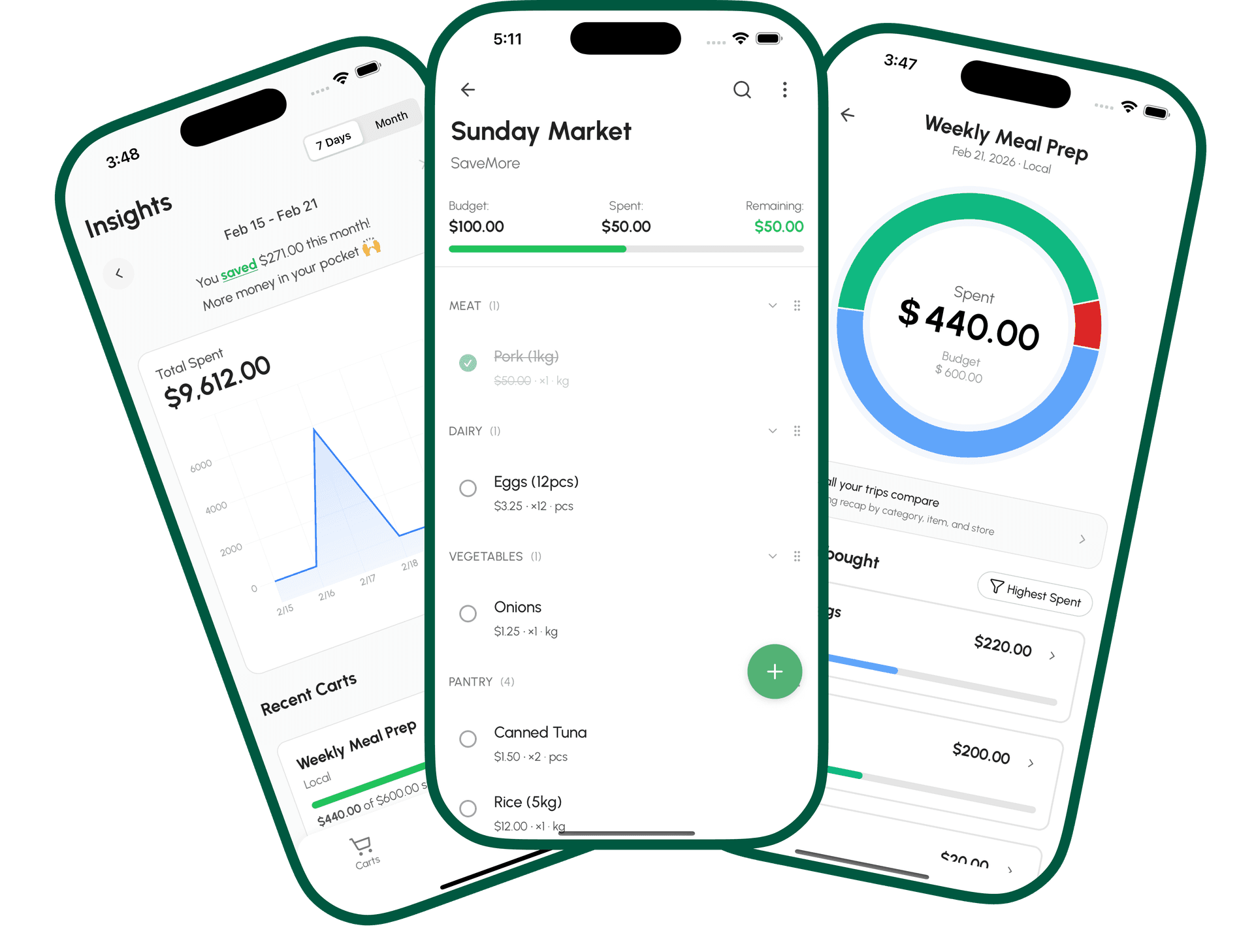
Everything runs on-device. Your carts, budgets, items, prices, templates, and insights are all stored locally. The app doesn't need to phone home to let you create a cart, add items, track your budget, or check off purchases.
No account required. You don't sign up, you don't log in, and you don't connect a bank account. Open the app, create a cart with a budget, and start shopping. This means there's nothing to authenticate against a server.
Price memory works offline. The app remembers what you paid for items at each store, and those suggestions appear without internet. Your price history is local data.
Voice add works offline. Voice dictation is free and unlimited, and it runs on your device using on-device speech recognition — so you can add items by voice with no signal at all. (AI camera scanning is the one feature that needs a connection, because the image is read by an AI model on our server. Everything else here works offline.)
Sync is optional, not required. If you use Family Sharing (Premium), sync happens when you have connectivity. But the app never blocks you from working because sync can't connect. Your data is always available locally, and it syncs when it can.
Stop guessing what your groceries cost
Free to use. Works offline, no account needed.
Offline Grocery App Comparison
| Feature | GroceryBudget | YNAB | Listonic | AnyList | Bring! |
|---|---|---|---|---|---|
| Works fully offline | Yes | No | Partial | Yes (lists only) | Partial |
| Budget tracking offline | Yes | No | No | No | No |
| Price memory offline | Yes | N/A | No | No | No |
| No account required | Yes | No | No | No | No |
| Real-time spending total | Yes | No | No | No | No |
| Spending insights | Yes | Yes (online) | No | No | No |
| Free tier available | Yes | No ($14.99/mo) | Yes (ads) | Yes | Yes (ads) |
Who Needs an Offline Grocery Budget App
You should prioritize offline support if:
- You regularly shop in stores where your phone loses signal
- You live in an area with unreliable cellular coverage
- You travel internationally and shop for groceries abroad
- You want your budget tracking tool to work reliably every single time, without exceptions
- You don't want to depend on Wi-Fi or data to manage your grocery spending
Offline support matters less if:
- You always have strong signal everywhere you shop
- You're fine with tracking expenses after you get home
- Your primary need is bank-synced transaction tracking (YNAB's strength)
The Bottom Line
An app that doesn't work when you need it isn't reliable. For grocery budgeting, "when you need it" is in the store, where signal is often worst. GroceryBudget is built offline-first — not as a compromise, but as a core design decision. Everything works without internet, always.
Download GroceryBudget and try it on your next trip — no account, no internet required.