Best Grocery Budget App for Philippines (2026)
Most grocery budget apps are built for the US. Filipino families need peso support, offline mode for spotty data, and tools that work at the palengke too.
Key Takeaways
• Most grocery apps are US-focused and don't handle peso budgets or multi-store Filipino shopping patterns.
• GroceryBudget supports PHP currency, works fully offline, and tracks prices across palengke and supermarkets.
• Price memory is especially valuable at wet markets where prices change daily.
• The free tier covers everything most Filipino families need — Premium is optional.
Track your grocery spending as you shop
Free to use. Works offline, no account needed.


If you've searched for a grocery budget app in the Philippines, you've probably noticed that most results are designed for American shoppers. Dollar-based pricing, US store integrations, bank syncing with American institutions — none of that helps when you're splitting your weekly budget between SM, Puregold, and the palengke.
Filipino families face specific grocery budgeting challenges that most apps ignore entirely.
What Makes Grocery Budgeting Different in the Philippines
Multi-store shopping is the norm. A typical Filipino family doesn't do one big weekly shop. You might hit the palengke for fresh produce and fish in the morning, SM or Puregold for canned goods and staples, and the neighborhood sari-sari store for quick fill-ins throughout the week. Tracking spending across all of these requires an app that handles multiple stores per budget cycle.
Price volatility. Prices at the wet market change daily based on supply. Chicken might be ₱180/kg on Monday and ₱220/kg on Friday. Rice prices shift with harvest cycles. You need price memory to know whether today's price is good or high.
Peso tracking. This seems obvious, but many apps default to USD and either don't support PHP or make it clunky to change. Currency support needs to be seamless, not an afterthought.
Spotty data coverage. Not every palengke or grocery store has reliable internet. In provincial areas, signal can be weak even inside malls. An app that needs internet to track your budget will fail you when you're standing in the market juggling bags and counting change.
Tight budgets with little margin. For many Filipino families, grocery budgeting isn't aspirational — it's essential. Going ₱500 over budget in a week means something else doesn't get paid. Real-time budget tracking isn't a nice-to-have; it's the whole point.
Why Most Apps Don't Work Here
YNAB ($14.99/mo / ~₱850/mo). A respected budgeting tool, but it costs almost as much as a day's worth of groceries for a family of four. It requires internet, connects to US/Canadian bank accounts, and doesn't work at the store level. It's designed for American households managing $4,000+ monthly budgets, not Filipino families stretching ₱8,000 a week.
Listonic. Has some list features, but it's ad-supported in the free tier and designed primarily for European and American markets. No real budget tracking. Not optimized for multi-store shopping patterns.
Bring! Popular for shared lists, but no budget tracking at all. You can share a list with your family, but nobody knows how much is being spent.
AnyList. US-focused, no budget tracking, requires an account, and charges for sharing features.
None of these apps were built with the Philippine market in mind.
How GroceryBudget Works for Filipino Shoppers
GroceryBudget supports the specific patterns Filipino families use:
PHP currency support. Set your currency to Philippine Peso and all budgets, prices, and insights display in ₱. No conversion math, no awkward workarounds.
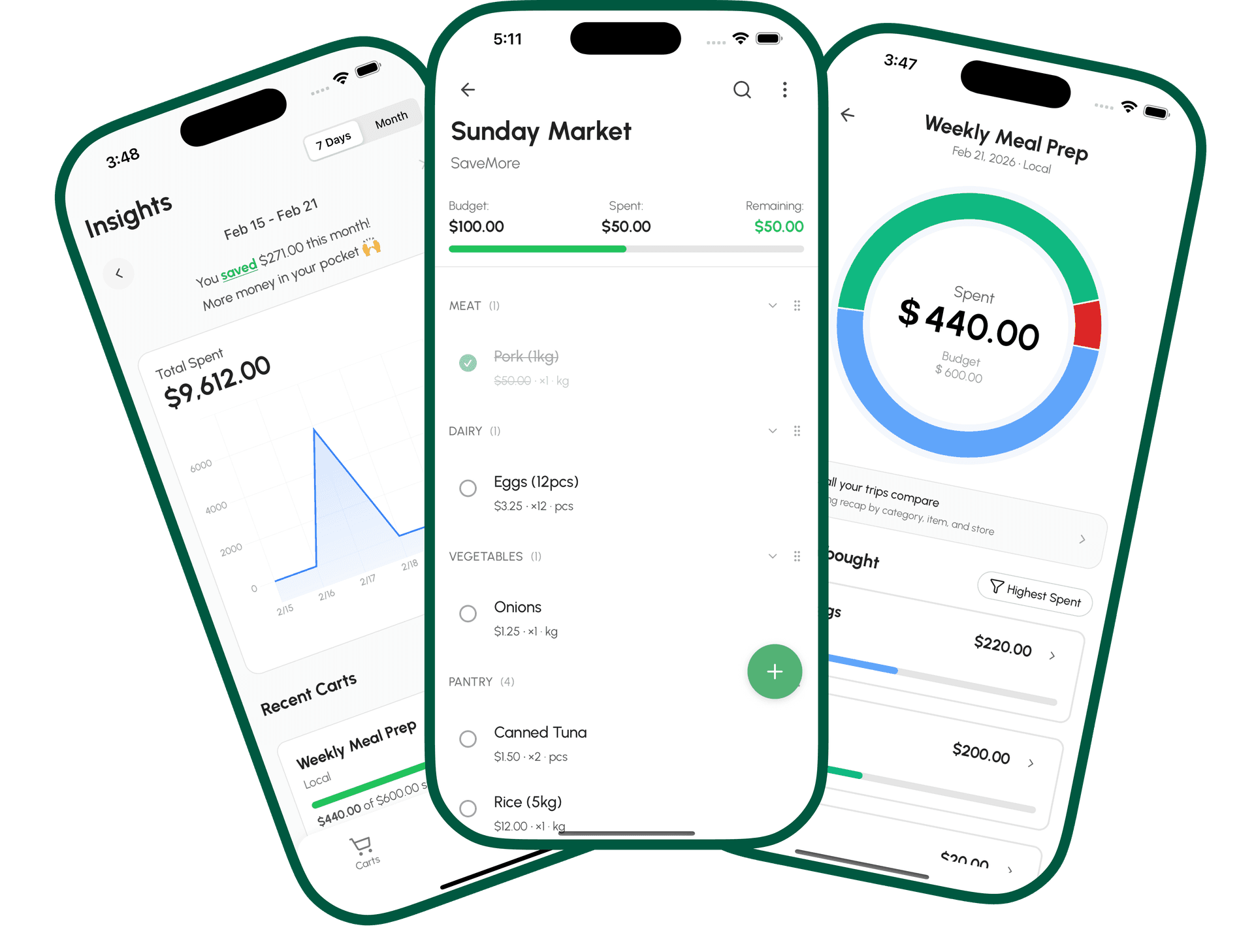
Per-cart budgets for each store. Create separate carts for your palengke run (₱800 budget), your SM trip (₱2,000 budget), and your weekly sari-sari purchases. Each cart tracks its own budget independently.
Price memory across stores. The app remembers that you paid ₱195/kg for chicken at the palengke and ₱230/kg at SM. Over time, you build a personal price database that tells you where each item costs less. This is especially valuable for wet market shopping where prices aren't posted.
Store comparison (Premium). See side-by-side price comparisons across your regular stores. Know whether Puregold or SM has better prices on your most-bought items. Compare wet market prices against supermarket prices with actual data from your own purchases.
100% offline. Every feature works without internet. Create carts, add items, track your budget, use price memory — all on-device. Your palengke at 6 AM with no signal works just as well as your SM trip with full Wi-Fi.
No account required. Open the app and start. No email, no signup, no phone verification. This matters in a market where people are rightly cautious about giving personal data to apps.
Affordable Premium. Premium is priced for the Philippines, not converted from dollars: ₱79/mo, ₱599/yr, or ₱1,290 for lifetime access. The free tier covers real-time budget tracking, price memory, 7-day insights, CSV export, and Smart Add voice dictation (unlimited free) and AI camera scanning (Premium, unlimited). Most Filipino families can use the free tier indefinitely and get real value.
Stop guessing what your groceries cost
Free to use. Works offline, no account needed.
Comparison for Philippine Shoppers
| Feature | GroceryBudget | YNAB | Listonic | Bring! |
|---|---|---|---|---|
| PHP currency support | Yes | Yes | Limited | Limited |
| Per-trip budget | Yes | No | No | No |
| Real-time spending total | Yes | No | No | No |
| Price memory | Yes | No | No | No |
| Multi-store comparison | Yes (Premium) | No | No | No |
| Works fully offline | Yes | No | Partial | Partial |
| No account required | Yes | No | No | No |
| Free tier (no ads) | Yes | No ($14.99/mo) | Yes (with ads) | Yes (with ads) |
| Cost in PHP | Free / ~₱228/mo | ~₱850/mo | Free (ads) / paid | Free (ads) |
Who This Is For
GroceryBudget is a good fit if you:
- Budget weekly in pesos and need to stick to a specific amount
- Shop at multiple stores (palengke, supermarket, sari-sari)
- Want to track prices and know which store gives better deals
- Need an app that works even with poor or no signal
- Don't want ads or data tracking in your grocery app
It's not the right fit if:
- You want a full personal finance tool that manages bills, savings, and debt (YNAB does that, at a cost)
- You primarily need recipe and meal planning features (AnyList is stronger there)
- You just want a pretty shared checklist with no budget concern (Bring! does that)
Tips for Getting the Most Out of It in the Philippines
- Start with your palengke trips. These have the most price variability. After a few trips, you'll have price memory for your regular items and you'll spot when prices spike.
- Create a template for your weekly staples. Rice, oil, eggs, onions, garlic, canned goods — the things you buy every week. Save it as a template so you don't rebuild the list from scratch.
- Track separately by store. Don't lump your palengke and SM purchases into one cart. Separate carts give you clean per-store spending data and better price comparisons.
- Check Insights weekly. After a month of tracking, your Insights tab will show which categories eat most of your budget. Most families discover that protein and snacks are the biggest budget drains.
- Use Smart Add for speed. At the wet market, things move fast. Smart Add lets you add items by voice — say "bangus two kilos one-ninety" and the item gets added with the price. Faster than typing while juggling bags.
The Bottom Line
Filipino families deserve a grocery budget app that understands how they actually shop — multiple stores, peso-based budgets, offline reliability, and tight margins where every peso counts. Most apps on the market weren't built for this. GroceryBudget was.
Download GroceryBudget and try it on your next palengke or supermarket run — no account needed, works offline, free to start.