Moving from Spreadsheets to GroceryBudget
Spreadsheets work for grocery budgeting — until you're standing in the aisle trying to update a formula on your phone. Here's how to make the switch.
Key Takeaways
• Spreadsheets are powerful for planning but painful for in-store use on a phone.
• GroceryBudget automates what you've been doing manually: price lookup, saved lists, spending charts.
• CSV export means you can use both during the transition — app in-store, spreadsheet at home.
• You lose total customization and complex formulas, but gain usability where it matters most.
Track your grocery spending as you shop
Free to use. Works offline, no account needed.


Spreadsheets are a perfectly valid way to track grocery spending. If you've been using Google Sheets or Excel to manage your grocery budget, you're already ahead of most people who don't track at all.
Spreadsheets are flexible, free, and you control everything. So why switch?
Why Spreadsheet Users Move to an App
The people who switch aren't spreadsheet haters. They got tired of specific friction points:
- Painful on your phone in-store. Tiny cells, accidental edits, slow loading while juggling a cart.
- Manual data entry every time. Every price, every item, every trip — you're typing it all in yourself.
- No real-time budget alerts. A spreadsheet can calculate a total, but it can't nudge you when you're approaching your limit while you're still shopping.
- Formulas break. One accidental delete, one shifted row, and your tracker shows nonsense.
- Hard to use while actually shopping. Spreadsheets are great at a desk. They're terrible in aisle 7.
The Transition: Step by Step
Step 1: Know Your Usual Items
Open your spreadsheet. Look at the last 3-4 weeks. You probably buy 70-80% of the same items every trip. Note those recurring items and their approximate prices.
Step 2: Download GroceryBudget
Get it from the App Store. No account needed.
Step 3: Create a Cart With Your Budget
Tap + to create a new cart. Set your store and weekly budget — the same number from your spreadsheet. Add your typical items with prices if you know them.
Step 4: Save as a Template
This is your spreadsheet's "master list" — but instead of copy-pasting rows each week, you tap one button to create a new cart from it.
Step 5: Let Price Memory Build
Use GroceryBudget for 2-3 trips. As you confirm prices at the store, the app remembers them. By trip three, prices auto-fill. This replaces your manual price entry.
Stop guessing what your groceries cost
Free to use. Works offline, no account needed.
What the App Handles That You Built Manually
- Price memory = your price lookup column. The app remembers what you paid last time.
- Templates = your saved weekly list. One tap instead of duplicating a sheet.
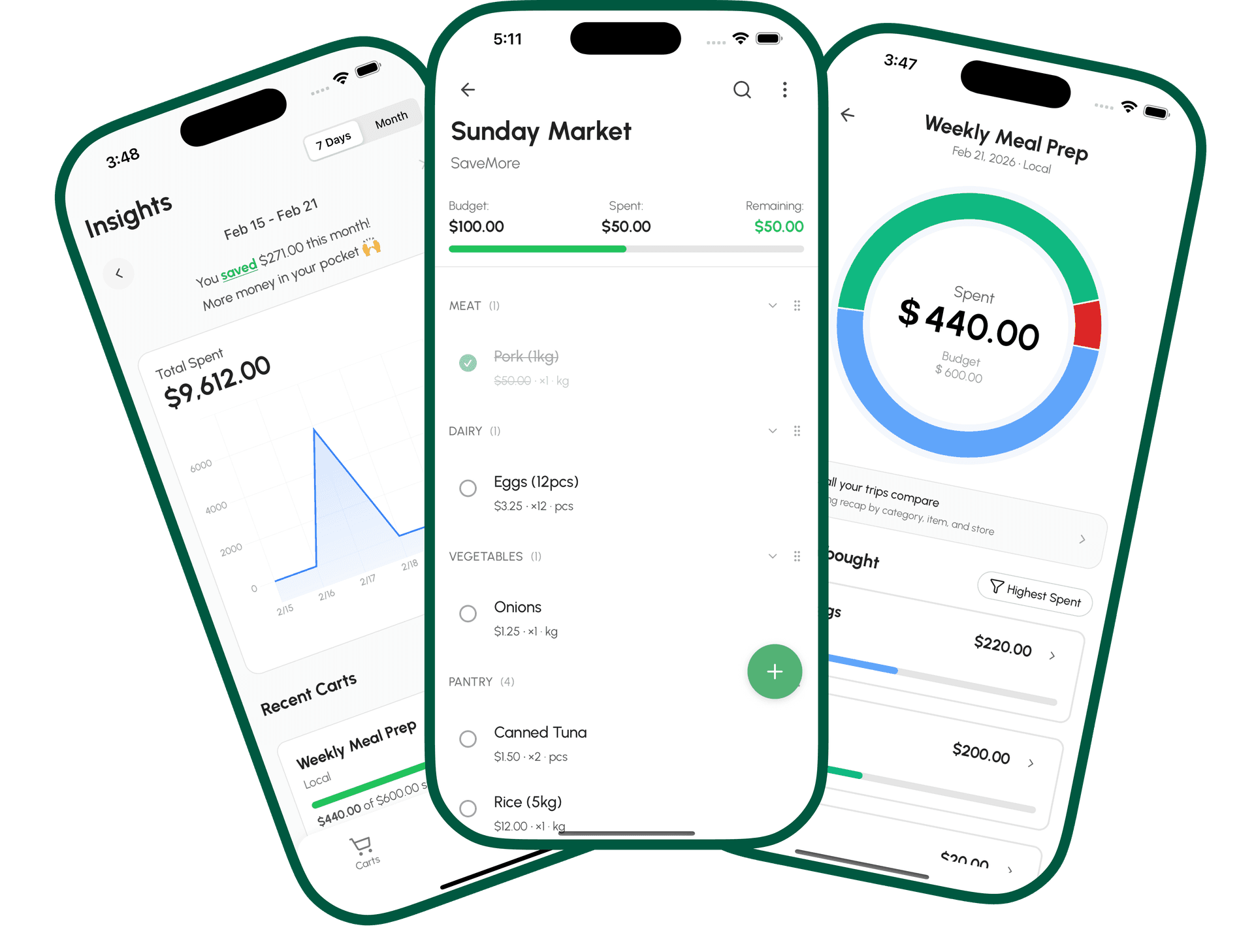
- Insights = your charts and pivot tables. Auto-generated spending breakdowns. Free tier covers 7 days; Premium gives unlimited history.
- Real-time budget bar = your SUM formula, but live. Updates as you check off items in-store.
You Can Still Export to a Spreadsheet
GroceryBudget supports CSV export on the free tier. Shop with the app in-store, then export your cart data for deeper analysis at home. You get the best of both worlds during the transition.
What You Gain
- Usability in the store. Purpose-built for one-handed use while shopping.
- Automation. Price memory, templates, and insights replace manual entry.
- Real-time tracking. Budget alerts while you shop, not after.
- Offline mode. Works without internet — your spreadsheet probably needs a connection to sync.
- No maintenance. Nothing breaks. No formulas to fix.
What You Lose
- Total customization. A spreadsheet can track macros, unit prices, per-serving costs, custom categories. GroceryBudget tracks what it tracks.
- Complex formulas and analysis. Conditional logic, rolling averages, cross-referencing other financial data — an app won't match that depth.
- Multi-platform editing. Your spreadsheet works on any browser. GroceryBudget is mobile-only (iOS and Android) — no web version.
- Historical data. Your spreadsheet history doesn't transfer. CSV export helps maintain continuity.
For the full feature breakdown, see GroceryBudget vs Spreadsheets.
Bottom Line
Spreadsheets are powerful. GroceryBudget is practical. If you're doing most of your budget tracking at a desk, keep the spreadsheet. If you're tired of fighting with cells while pushing a cart, GroceryBudget handles the in-store experience better. And with CSV export, you don't have to choose — use both until you're ready to commit.
Download GroceryBudget — free, no account needed.