YNAB vs GroceryBudget: Which Is Better?
YNAB is a full financial system at $14.99/mo. If you just want to control grocery spending in the store, you're paying for features you'll never use.
Key Takeaways
• YNAB tracks your full financial life but sees groceries as one monthly total — it can't warn you while you're still in the aisle.
• GroceryBudget is purpose-built for the store: per-trip budgets, real-time totals, price memory, and offline support.
• Use YNAB for whole-life budgeting; use GroceryBudget if groceries are your main concern — or run both.
Track your grocery spending as you shop
Free to use. Works offline, no account needed.


YNAB (You Need a Budget) is one of the most respected personal finance apps available. It's thorough, it's opinionated, and it works — for people who want to manage their entire financial life in one place.
But YNAB costs $14.99 a month. And if groceries are your main concern, most of what you're paying for has nothing to do with what happens at the store.
What YNAB Does
YNAB is a zero-based budgeting system. Every dollar you earn gets assigned to a category — rent, utilities, dining out, groceries, savings, and so on. It syncs with your bank accounts, tracks transactions, and helps you see where all your money goes across your entire budget.
For people who want that level of oversight, it's genuinely valuable. If you're trying to get out of debt, build an emergency fund, or manage variable income, YNAB's methodology is sound.
But YNAB's approach to grocery budgeting is the same as its approach to everything else: you set a monthly category budget, your grocery transactions sync in (or you enter them manually), and you see how much of your monthly grocery budget remains.
That's it. That's the grocery feature.
What YNAB Doesn't Do at the Store
YNAB is a post-purchase tool for groceries. Here's what it can't do:
It doesn't work in real time while you shop. You add items to your cart and find out what you spent at the register. YNAB records that transaction later — after the money is already spent.
It doesn't track individual items or prices. YNAB sees your grocery transaction as a single dollar amount from the store. It has no idea that eggs went up $1.50 or that you spent half your budget on snacks.
It doesn't remember item prices. No price suggestions, no price history, no way to know whether you're paying more or less than last time.
It doesn't warn you mid-shop. You might have $40 left in your monthly grocery category when you walk into the store, but YNAB can't tell you "you're at $35 and still need to grab meat" while you're standing in the produce section.
It doesn't track by store. One grocery line item covers everywhere — the big weekly shop, the quick stop for one thing, the pharmacy where you grabbed bread.
For a $14.99/mo subscription, that's a significant gap in grocery-specific functionality.
Where GroceryBudget Fits
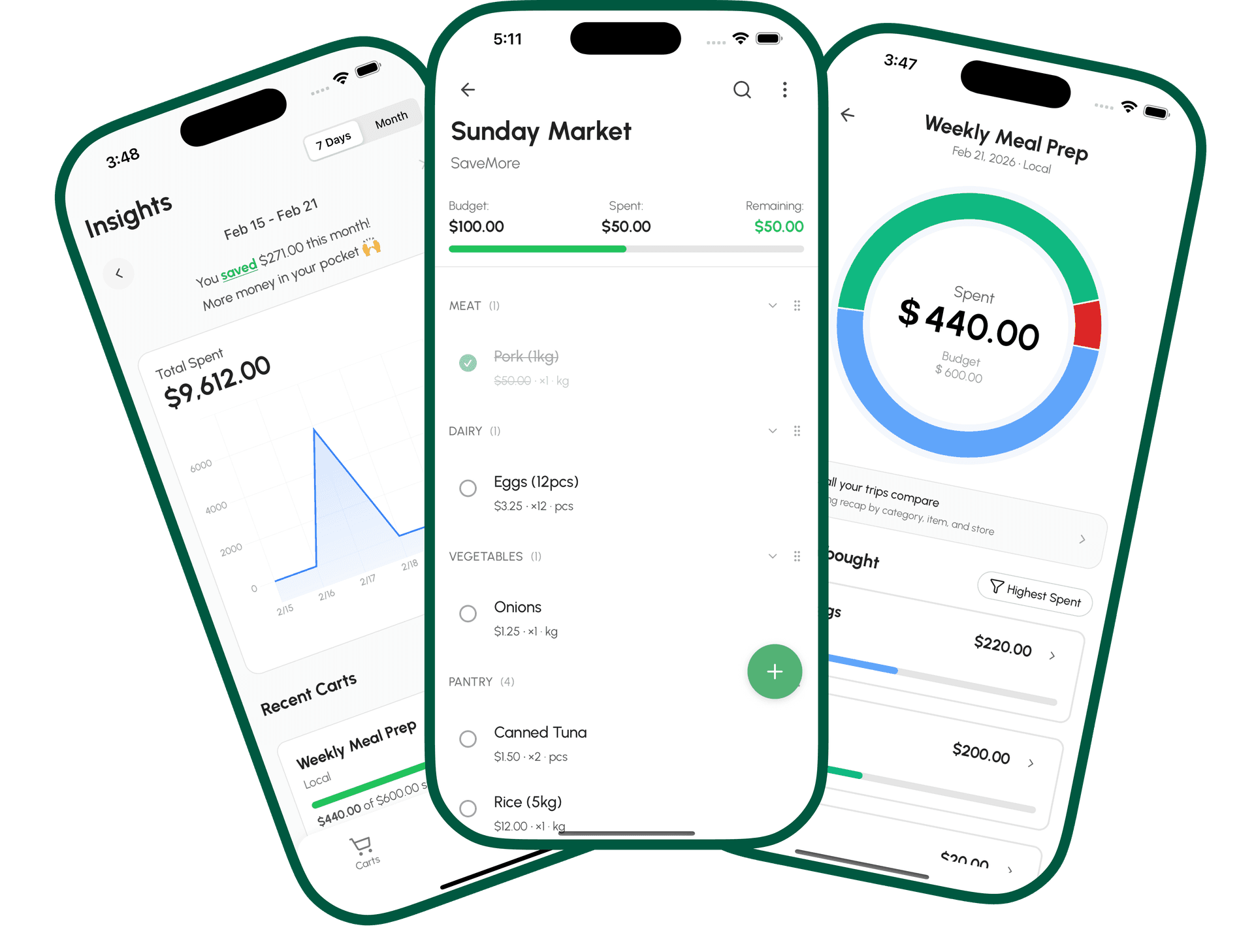
GroceryBudget is purpose-built for the grocery store, not for your entire financial life. It doesn't replace YNAB — some users run both. But for anyone whose main budgeting concern is groceries, it does more where it matters.
Per-trip budgets. Each cart gets its own budget. A Costco stock-up has a different budget than a midweek fill-in. You're not trying to mentally subdivide one monthly category.
Real-time tracking while you shop. Add items with prices as they go in the cart. Your running total updates immediately and a budget bar shows how much room you have left. You know before checkout whether you need to put something back.
Price memory. The app remembers what you paid for each item at each store. Next time you add the same item, it suggests your last price. Over time, you can see if prices are going up and find which store has the better deal.
Item-level insights. After your trips, you can see which categories took the most of your budget (Meat vs. Produce vs. Snacks) and which items you buy most often. That detail tells you where to cut if you need to.
Store comparison. Premium users can compare item prices across stores to find where they're consistently overpaying.
Offline-first. Works without internet, which matters because grocery store cell coverage is unreliable.
No account needed to start. Open the app and you're in. No signup, no bank connection, no setup process.
Stop guessing what your groceries cost
Free to use. Works offline, no account needed.
The Cost Comparison
YNAB costs $14.99/mo or $109/yr.
GroceryBudget's free tier covers real-time tracking, price memory, basic insights, and Smart Add voice dictation (free and unlimited). Premium adds AI camera scanning (unlimited), unlimited insights history, custom templates, price history, and store comparison — at $9.99/mo, $29.99/yr, or $79.99 lifetime.
If your goal is controlling grocery spending, GroceryBudget is purpose-built for exactly that problem at a fraction of the cost — or free.
Which One to Use
Use YNAB if:
- You want to manage your complete household budget (rent, utilities, savings, debt) in one place
- You want bank sync and automatic transaction categorization
- Your grocery overspending is part of a broader pattern of budget mismanagement
- You're willing to invest time in learning a full budgeting methodology
Use GroceryBudget if:
- Groceries are your main area of concern
- You want real-time budget tracking while you're actually shopping
- You want to track prices and see where items cost less
- You want something lightweight that works immediately, without a learning curve
- You don't want to pay $14.99/mo to track your weekly grocery run
Use both if:
- You're serious about your complete financial picture and want granular grocery tracking on top of YNAB's broader oversight
The two apps don't compete on the same ground. YNAB is your whole financial system. GroceryBudget is your grocery system. If you only need one, be honest about which problem you're actually trying to solve.
See the full comparison at GroceryBudget vs YNAB.
Download GroceryBudget and run your next shopping trip with it for free.