The $200/Month Grocery Hack That Isn't Couponing
No coupons, no extreme strategies, no store-hopping. Just one habit that cuts grocery spending by $200/month on average.
Key Takeaways
• Why budget tracking beats couponing for long-term savings.
• The specific behaviors that change when you see your data.
• How to start tracking without making it a chore.
Track your grocery spending as you shop
Free to use. Works offline, no account needed.


Search "how to save money on groceries" and you'll get the same advice recycled since 2012: clip coupons, meal prep on Sundays, buy in bulk, switch to store brands, drive to three different stores for the best deals.
Some of that works. Most of it doesn't stick. Meal prepping takes hours. Couponing turns grocery shopping into a part-time job. And nobody actually enjoys comparing flyers from four stores every week.
There's a simpler approach that consistently saves families around $200 per month. It's not glamorous. It won't go viral on TikTok. But it works: track your grocery spending.
That's it. No scissors required.
Why Tracking Works Better Than Couponing
Couponing saves you money on individual items. Tracking changes how you spend across every trip, every store, every month. The difference is structural.
When you actively track what you spend on groceries, five things happen — and each one shaves money off your bill without requiring willpower or extra effort.
1. You Discover Your Real Baseline
Most people think they know what they spend on groceries. They're wrong. Studies on consumer spending estimation show that people underestimate their grocery costs by roughly 25%. If you think you spend $600 a month, your actual number is probably closer to $750-$800.
You can't set a meaningful budget when your starting number is fiction. Tracking for even two weeks gives you a real baseline — and that number alone is often enough to trigger change. Seeing "$847 last month" in black and white hits different than a vague sense that groceries "feel expensive."
2. Quick Trips Become Visible
Here's a number that surprises people: about 31% of grocery spending comes from unplanned trips. The "I just need milk" run that turns into $45 at checkout. The Thursday evening stop because you forgot something for dinner. The weekend snack run with the kids.
These trips are invisible when you're not tracking. Each one feels small. But three or four a month at $35-$50 each? That's $100-$200 in spending you never budgeted for and barely remember.
When you track every trip — not just the big weekly shop — these patterns surface fast. You see exactly how many "quick" runs you're making and what they actually cost. Most people cut their unplanned trips in half once they see the data.
3. Category Creep Surfaces
Track your spending by category for a month and you'll likely find a surprise: snacks and convenience foods quietly rival what you spend on meat and produce. It's not unusual for a family to spend $120-$150 per month on chips, crackers, granola bars, pre-made snacks, and drinks — categories that feel like small add-ons but accumulate fast.
One GroceryBudget user discovered they were spending $90 a month on snack foods alone. Not by going on a diet or making a rule — just by seeing the category breakdown. They trimmed it to $40 without feeling deprived, mostly by cutting duplicates and items nobody in the house was actually finishing.
That's $50 per month from one category, from one insight.
4. Store Loyalty Gets Questioned
You probably shop at the same store every week. It's close, you know the layout, it's habit. But price memory — tracking what you pay for the same items over time — reveals something interesting: your regular store may be costing you $35-$45 more per month on staples alone compared to an alternative.
You don't need to visit five stores. You just need to know which items are meaningfully cheaper elsewhere. Maybe your go-to store is great for produce but 20% more expensive on pantry staples. Splitting your shopping between two stores based on actual price data — not gut feeling — is one of the highest-value changes trackers make.
5. You Set Real Budgets Instead of Vibes
"I should probably spend less on groceries" is not a budget. It's a feeling. And feelings don't survive the cereal aisle.
A real budget is a specific number you can see while you're shopping. Budget alerts that tell you "you've spent $340 of your $500 monthly budget" mid-trip actually change decisions. You put back the $8 fancy cheese. You skip the second case of sparkling water. Not because you're depriving yourself, but because you can see where you stand in real time.
People who set and monitor a grocery budget spend 15-20% less than those who shop without one. That's not discipline — it's information.
Stop guessing what your groceries cost
Free to use. Works offline, no account needed.
The Couponing Comparison
Let's be honest about coupons. The average coupon saves $1-$2 per item. A dedicated couponer might save $5-$15 per trip, which sounds decent until you factor in the time spent finding, clipping, and organizing coupons — plus the fact that coupons often push you toward products you wouldn't otherwise buy.
A "great deal" on a brand you don't need isn't savings. It's spending you wouldn't have done otherwise, just at a lower price.
Tracking doesn't have this problem. It doesn't push you toward specific products. It just shows you what's actually happening with your money and lets you decide what to change.
The Numbers Are Hard to Argue With
The average American household spends about $1,546 per month on food, with groceries making up the bulk of that. Even a conservative 10% reduction from better awareness — no extreme measures, no lifestyle changes — saves over $150 per month. Families who actively track and adjust typically see $150-$250 in monthly savings within the first two to three months.
That's $1,800-$3,000 per year. From paying attention.
How to Make Tracking Easy
The reason most people don't track grocery spending is that it sounds tedious. And if you're picturing a spreadsheet where you manually enter every item, it is tedious. That's why most spreadsheet-based tracking gets abandoned within two weeks.
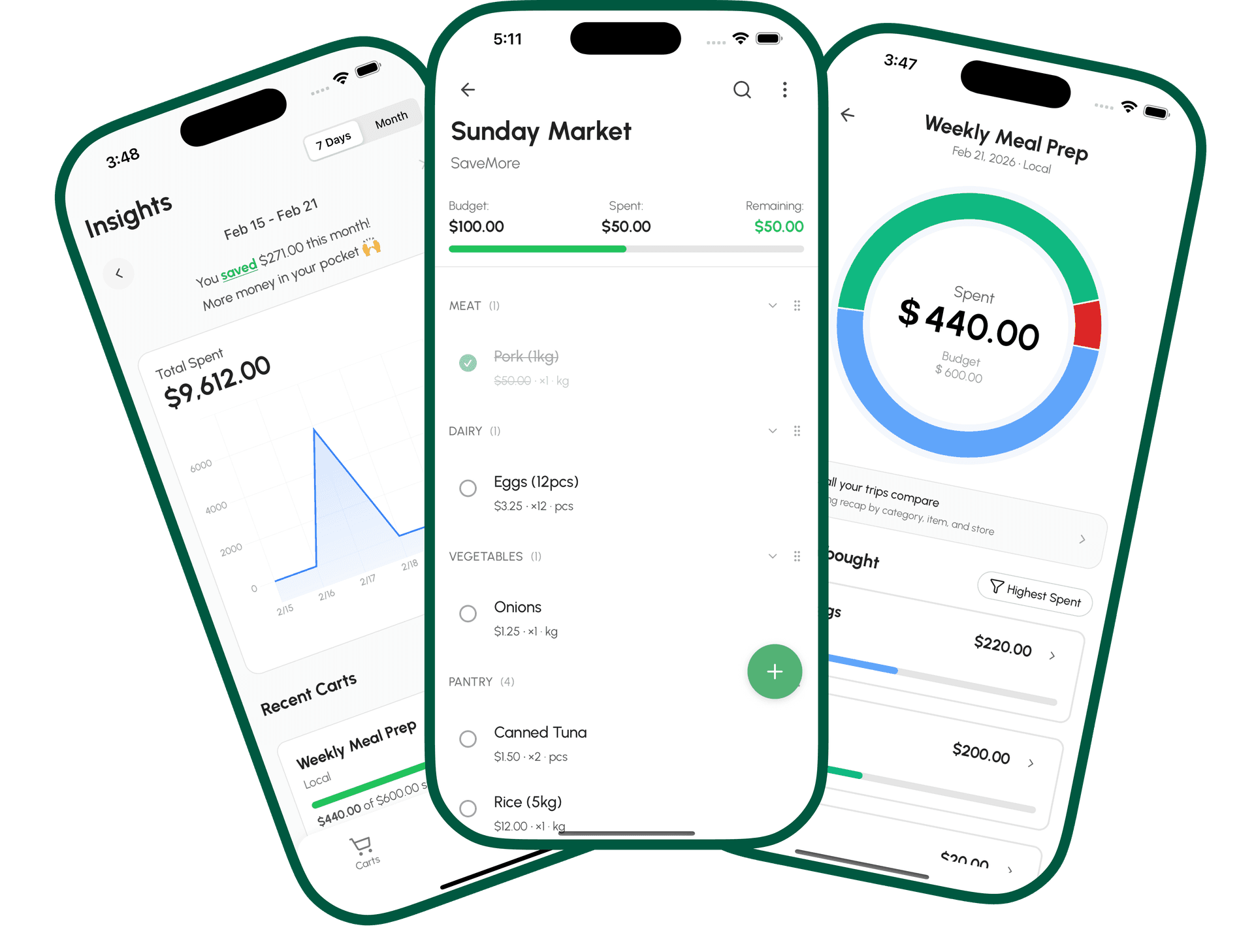
The key is making it take less than 30 seconds per trip. Tools like GroceryBudget are built specifically for this — you log your trip total, categorize if you want to, and the app handles the rest. Budget alerts, spending insights, category breakdowns, and price memory all work in the background. You get the data without the data entry.
But even if you use a notes app or the back of an envelope, the act of recording what you spent changes your relationship with grocery money. The tool matters less than the habit.
Start Small
You don't need to overhaul your grocery routine. You don't need to switch stores, change what you eat, or spend your Sunday afternoon prepping meals in containers.
Start by tracking your next 5 trips. That's it. Write down the store, the date, and the total. If you want to go further, note what categories made up the bulk of the bill.
After 5 trips, look at the numbers. You'll see something you didn't expect. Maybe it's how much those midweek runs actually cost. Maybe it's a category that's quietly eating your budget. Maybe it's just that your monthly total is higher than you thought.
Whatever it is, the data will tell you what to change. And unlike couponing, you won't need scissors to do it.