Weekly vs Monthly Grocery Budget: Which Works Better?
A monthly grocery budget sounds right but fails in practice. A weekly one is more actionable but harder to set. Here's which works better, and how to build it.
Key Takeaways
• Why monthly budgets fail at the store and weekly budgets fail at planning.
• The hybrid approach that combines the benefits of both.
• How to set your weekly number based on your monthly target.
Compare stores using your own grocery history
Remember the prices you paid and see which store is cheaper for the items you buy.
See price history and store comparison →

Most people think about their grocery budget in monthly terms — "we spend about $500 a month on groceries." But most people shop weekly. That mismatch is one of the main reasons grocery budgets fail.
Here's the practical difference between the two approaches and which one actually works.
The Problem With Monthly Budgets
A $500/month grocery budget sounds concrete until you're standing in a store on a Tuesday trying to decide whether to buy the $14 rotisserie chicken. Is $14 within budget this week? You don't know — you haven't been tracking daily, you shopped twice already this month, and doing that mental math mid-aisle is too much friction.
Monthly budgets work well as a planning and review tool. They're terrible as an in-the-moment decision tool.
The other problem: months aren't evenly spaced by shopping trips. Some months have 4 shopping trips, some have 5. If you budget $500/month and have 5 trips in March, your effective per-trip budget is $100 — but you didn't know that when you spent $140 on trip one.
The Problem With Weekly Budgets
A $125/week grocery budget is more actionable. But it's harder to set accurately and creates a rigidity that doesn't match real shopping patterns.
Some weeks you do a big pantry stock-up and spend $180. The next two weeks you spend $75 because you're drawing down what you bought. A strict weekly budget treats the $180 week as a failure when it was actually efficient.
Weekly budgets also don't account for monthly expenses that happen to fall in a particular week — a big batch cook, a dinner party, or a month where you restocked cleaning supplies with your grocery run.
The Better Approach: Monthly Target, Weekly Tracking
The combination that works:
- Set a monthly target — this is your planning number. Based on your income, household size, and what you've actually spent before.
- Divide by 4.3 (the average number of weeks per month) to get a baseline weekly number. If your monthly target is $520, your baseline weekly budget is $120.
- Track per trip, not per week — each shopping trip gets its own budget based on what you need. A stock-up trip might have a $160 budget; a midweek fill-in trip might be $40.
- Compare to your monthly target at the end of each week — are you on pace? Ahead? Behind?
This gives you monthly-level visibility for planning and per-trip visibility for in-store decisions.
Compare stores using your own grocery history
Remember the prices you paid and see which store is cheaper for the items you buy.
See price history and store comparison →Setting Your Monthly Target
If you don't know your current monthly grocery spend, you need 4 weeks of tracking before you can set a meaningful target. Most people discover they're spending 15–25% more than they thought.
USDA 2026 benchmarks as a starting reference:
| Household | Thrifty | Moderate |
|---|---|---|
| 1 adult | $230–$260 | $380–$420 |
| 2 adults | $420–$470 | $700–$770 |
| 2 adults + 1 child | $520–$570 | $830–$910 |
| 2 adults + 2 children | $630–$690 | $980–$1,080 |
These are guidelines, not rules. Your number depends on where you live, how often you cook, and what you eat.
How GroceryBudget Handles This
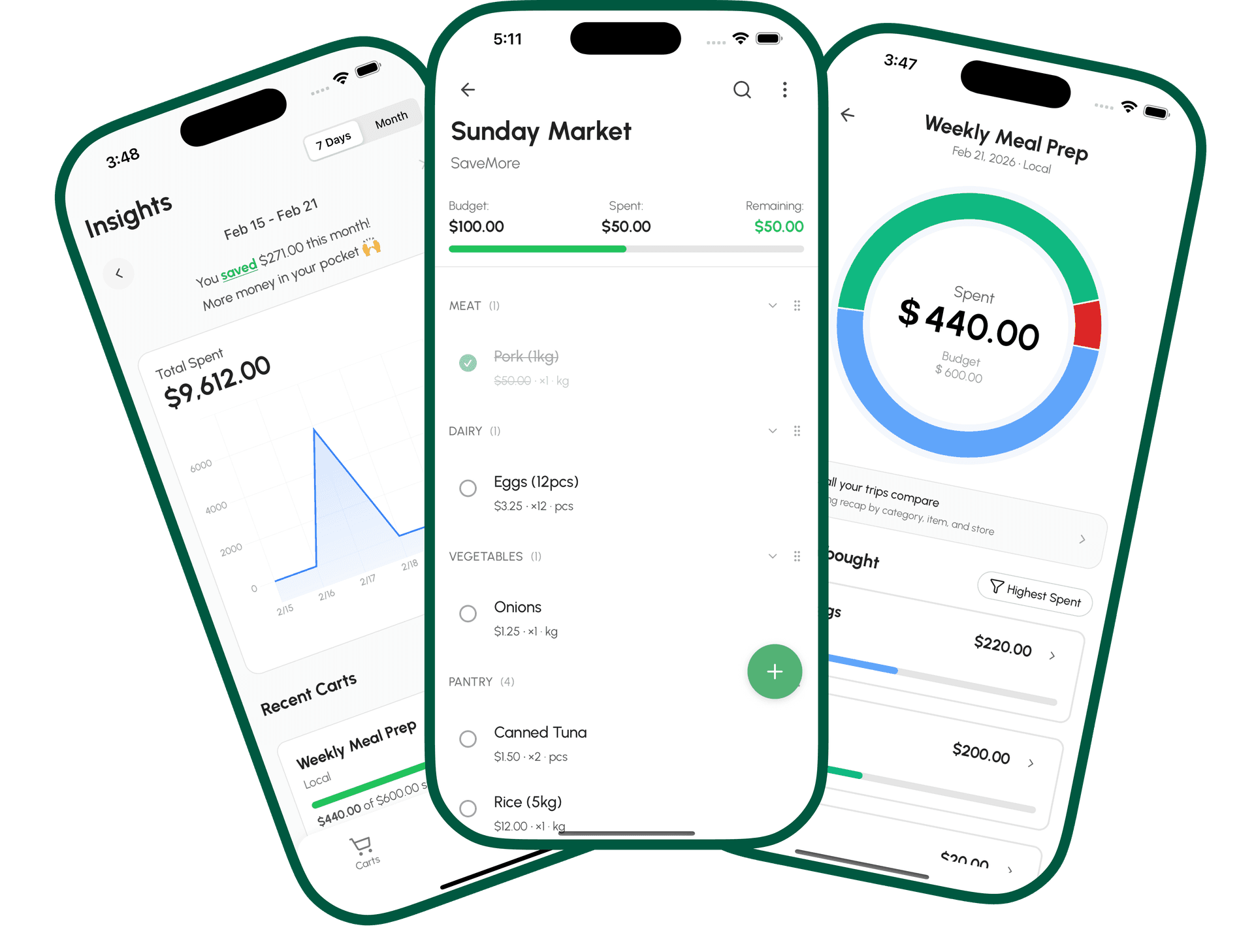
GroceryBudget tracks at the trip level — each cart has its own budget — while also showing you cumulative spending by week and month in the insights view. You can set a per-trip budget of $120 while knowing your monthly pace is on track toward $520.
The free tier includes 7 days of spending history. Premium unlocks your full monthly and historical view.
Download GroceryBudget — free, offline, no account required.