How to Find the Cheapest Groceries Near You
You don't need to drive to five stores to find the best prices. Here's a practical system for finding cheap groceries near you, using your own data.
Key Takeaways
• Why generic price comparison sites don't reflect your local store prices.
• How to build a personal price map across your regular stores in 3–4 trips.
• The fastest way to know which store wins on your specific items.
Compare stores using your own grocery history
Remember the prices you paid and see which store is cheaper for the items you buy.
See price history and store comparison →

The generic answer to "where are groceries cheapest?" is Aldi, Lidl, or Walmart. That's statistically true on a basket-wide level. But it doesn't account for what you specifically buy, which stores are actually near you, or the fact that prices vary by region, by week, and by promotion cycle.
The real question isn't "which chain is cheapest?" It's "which store near me is cheapest on the 40 items I buy every week?"
Those are different questions with different answers.
Why Generic Price Comparison Tools Fall Short
Apps and websites that compare grocery prices have a fundamental problem: they rely on reported or scraped data that's often days or weeks out of date, doesn't reflect local pricing variations, and doesn't cover every store in your area.
A price comparison site might tell you chicken is $4.99/lb at Store X. Your local Store X might be charging $5.49 because of regional pricing. Or it might be on sale for $3.99 this week. The site won't know either.
The only prices that matter are the ones at the stores you actually shop at, updated as often as prices change.
The Better Approach: Build Your Own Price Map
The most accurate grocery price comparison is one you build yourself — passively, over 3–4 normal shopping trips.
Here's how it works:
Trip 1: Shop your usual store. Record the price of each item as you add it to your cart. You're not doing extra work — you need to enter these anyway if you're tracking your budget.
Trip 2: Shop a different store (or the same one — prices change). The app records prices again. It now has two data points for each item.
After 3–4 trips across two stores: You have a clear picture of which store consistently charges less for which items. Not averages from a database — your actual local prices on the things you actually buy.
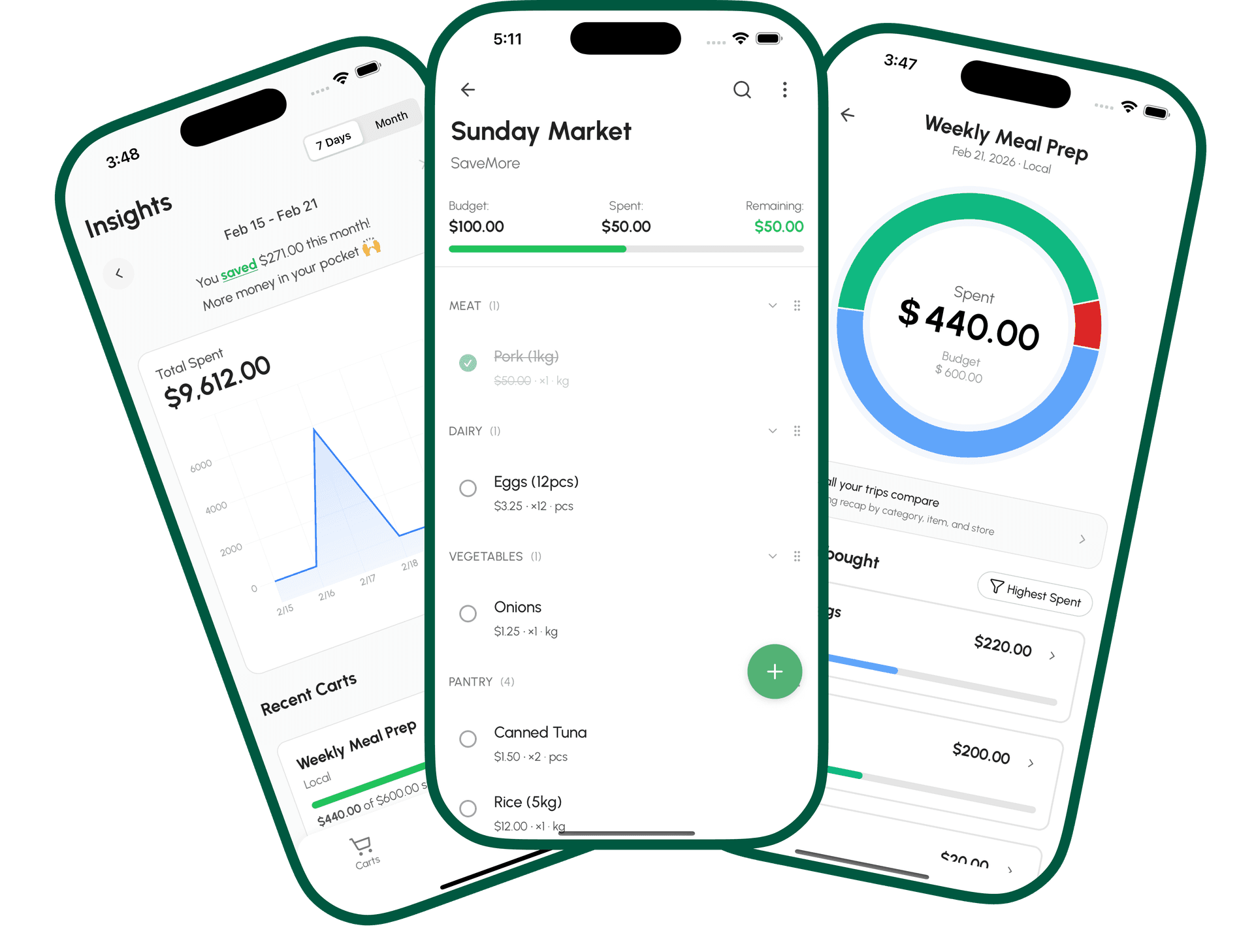
This is exactly what GroceryBudget's price memory feature does. Every item you buy is remembered with its price, date, and store. After a few trips, you can pull up any item and see what you paid at each store the last several times you bought it.
Compare stores using your own grocery history
Remember the prices you paid and see which store is cheaper for the items you buy.
See price history and store comparison →What the Data Usually Reveals
Most people who run this comparison for a month find the same pattern:
- One store wins on produce and fresh items — usually the one with more turnover or a better location for fresh supply.
- The other store wins on packaged and branded goods — particularly during their promotion cycles.
- House brands are almost always cheaper than name brands regardless of store — and often identical quality.
- The price gap on staples is smaller than expected — the big savings come from knowing when to buy, not just where.
A Practical Two-Store Routine
Rather than visiting five stores to cherry-pick deals, most households save the most with a two-store strategy:
- Identify your top 10–15 highest-spend items — these are where the price differences add up.
- Track prices at your two nearest stores over 3–4 weeks.
- Assign each category to whichever store wins on it.
- Do one primary shop at the store that wins on more of your items.
- Supplement monthly at the secondary store for the categories it wins on.
This approach saves $30–$80/month for most households without adding significant shopping time.
Getting Started
GroceryBudget is free to download and starts building your price history on the first trip. No setup required — create a cart, add items as you shop, and the price comparison data builds automatically over time.
Download GroceryBudget — free, offline, no account required.