Best Bring! Alternative With Budget Tracking (2026)
Bring! makes shared grocery lists look good. But it can't tell you how much you're spending or help you stick to a budget. Here's what to use instead.
Key Takeaways
• Bring! has polished visual design and shared lists but zero budget tracking — you find out what you spent at the register, not before.
• GroceryBudget adds a real-time budget bar and price memory on top of shared list management.
• The most important moment in grocery budgeting is while you're still in the store — that's when you can still make trade-offs.
Track your grocery spending as you shop
Free to use. Works offline, no account needed.


Bring! has a nice visual design. Items show up as product images rather than plain text, categories are clean, and it's easy to share lists with family members. For a household that just wants a prettier version of the default Notes app, it works.
But Bring! has no budget tracking. None. You can build a beautiful list of 30 items and have no idea whether you're about to spend $60 or $160 at the register.
If you're trying to stick to a grocery budget, that's a dealbreaker.
What Bring! Is Good At
Bring!'s strengths are in the presentation and sharing layer:
- Visual product cards instead of plain text items
- Simple real-time sharing between household members
- Clean category organization
- A recipe import feature
- A "to buy" and "done" separation while shopping
It's well-designed for the experience of making and checking off a list. The product images help people recognize items quickly, which is genuinely useful if multiple family members are shopping together.
What Bring! Can't Do
Bring! doesn't track money. That means:
- No price entry for any item
- No running total while you shop
- No budget limit per trip
- No warning before you hit the register
- No record of what things cost over time
- No way to compare prices between stores
- No spending history or insights
The app can tell you that "eggs" is on your list. It can't tell you that eggs went from $3.50 to $5.99 at your store, or that you've already spent $80 and only have $20 left in your budget.
Why This Matters in Practice
Most people overestimate their ability to track spending in their head. You go in thinking "$100 should be plenty" — but by the time you've filled the cart and reached checkout, the total is $135.
What went wrong? Usually it's the accumulation of small things: the fancy bread instead of the store brand, an extra snack, produce that was more expensive than you expected, a household item you forgot to account for.
A budget app catches this in real time. You can see "I'm at $85 and still need meat" while you're standing in the produce section — which means you still have the chance to make trade-offs. With Bring!, you find out at the register when it's too late.
GroceryBudget as a Bring! Alternative
GroceryBudget handles shared list management and adds the budget layer that Bring! is missing.
Shared carts via Family Sharing. Premium users can share a subscription with up to 5 family members, each with their own access to carts, templates, and tracking.
Visual categories. Each item category has a color label, so your cart is organized at a glance — not as beautiful as Bring!'s product images, but functionally equivalent for navigating a list by section.
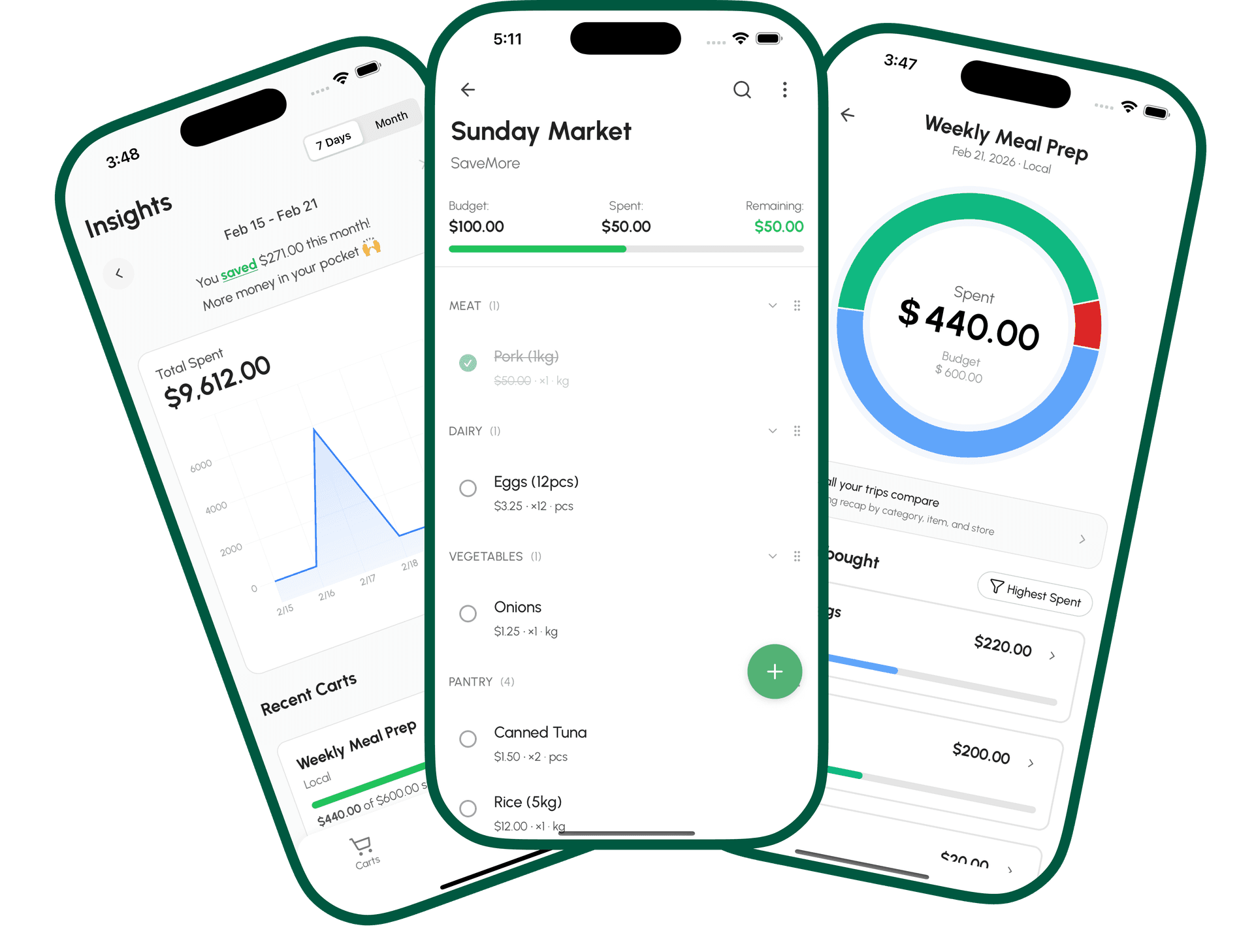
Real-time budget tracking. Set a budget for the trip, then add items with prices as you shop. The budget bar updates immediately. You always know where you stand.
Price memory. The app remembers what you paid for each item at each store. Adding regular items on your next trip takes one tap — no retyping prices.
Smart Add. Use your voice ("2 lbs ground beef $6.99") or your camera to scan a product label. Smart Add parses the name, quantity, and price automatically. Voice dictation is free and unlimited; AI camera scanning includes 3 free scans, then Premium unlocks unlimited.
Spending insights. After you complete a trip, your data feeds into Insights. You can see spending by category, by store, and over time. Bring! has no equivalent.
Offline first. Budget tracking, price memory, and voice add all work without internet (only AI camera scanning needs a connection). Bring! requires a connection for real-time sharing, which breaks down in stores with poor coverage.
No account required. Open GroceryBudget and start immediately. Create an account when you want to sync across devices — your data transfers automatically.
Stop guessing what your groceries cost
Free to use. Works offline, no account needed.
Side by Side
| Feature | Bring! | GroceryBudget |
|---|---|---|
| Shared lists | Yes | Yes (Family Sharing, Premium) |
| Visual product images | Yes | No (category colors instead) |
| Recipe import | Yes | No |
| Per-trip budget | No | Yes |
| Running total while shopping | No | Yes |
| Price memory | No | Yes |
| Spending insights | No | Yes |
| Store comparison | No | Yes (Premium) |
| Offline support | Partial | Full |
| Free to start | Yes | Yes |
| No account required | No | Yes |
Who Should Switch
Switch to GroceryBudget if:
- You have an actual grocery budget and want to stick to it
- You want to know what things cost and track price changes over time
- You shop at multiple stores and want to compare
- You want spending data you can look back on
Stick with Bring! if:
- Budget tracking doesn't matter to you
- The visual product card design is important to your household
- You mainly want a shared list that's easy for the whole family to use
If budget visibility is what you're missing, Bring! won't get you there — no amount of updates or workarounds will add a feature that isn't in the app's design.
For a full feature breakdown, see the GroceryBudget vs Bring! comparison page.
Switching from a different app? See the best Listonic alternative and best AnyList alternative guides.
Download GroceryBudget and start your first cart for free.