Best Listonic Alternative Without Ads (2026)
Listonic's free version is increasingly ad-heavy, with no budget tracking. Here's a cleaner alternative that also tells you what you're spending.
Key Takeaways
• Listonic's free tier is ad-heavy; even paid Listonic has zero budget tracking — no prices, no totals, no spending history.
• GroceryBudget has no ads on any tier; the free version includes real-time budget tracking, price memory, and unlimited Smart Add voice dictation.
• If you were paying for Listonic just to remove ads, GroceryBudget Premium gives you a clean experience plus full budget tracking for a similar cost.
Track your grocery spending as you shop
Free to use. Works offline, no account needed.


Listonic has been around for a long time. It's functional, it has a solid item database, and it handles shared lists reasonably well. But two things are pushing people to look for alternatives in 2026.
First: the free version is heavy on ads. Banners, interstitials, and persistent ads throughout the app make the free experience noticeably degraded. Paying to remove them adds another subscription to the pile.
Second: even if you pay, Listonic still can't help you track your grocery budget. There are no per-trip budgets, no running totals, no price memory, no spending history. It's a list app, and it's only ever been a list app.
If you're looking for something cleaner — and something that actually helps you spend less — here's what the alternative looks like.
The Ad Problem
Listonic's ad placement is aggressive by grocery app standards. You're in the middle of shopping, checking off items while juggling a cart and your phone, and you're dealing with banner ads fighting for attention on the screen.
The free-to-paid conversion is how the app sustains itself, which is understandable. But the trade-off is a noticeably worse experience for people who don't want to pay another monthly fee just to remove ads from a shopping list.
GroceryBudget has no ads. The free tier is the full app with feature limits, not a degraded experience designed to push you toward a purchase.
The Budget Gap
The bigger issue — ads aside — is that Listonic doesn't track spending. You can have a perfectly organized list and no idea whether this trip is going to cost you $80 or $150.
Listonic doesn't:
- Let you enter a price for any item
- Show a running total as you add items to your cart
- Set a per-trip spending limit
- Warn you before you go over budget
- Remember what things cost from trip to trip
- Show how your grocery spending changes over time
- Compare prices between stores
This makes it a list manager, not a budget tool. For shoppers who need both, that's a significant gap.
What GroceryBudget Does Differently
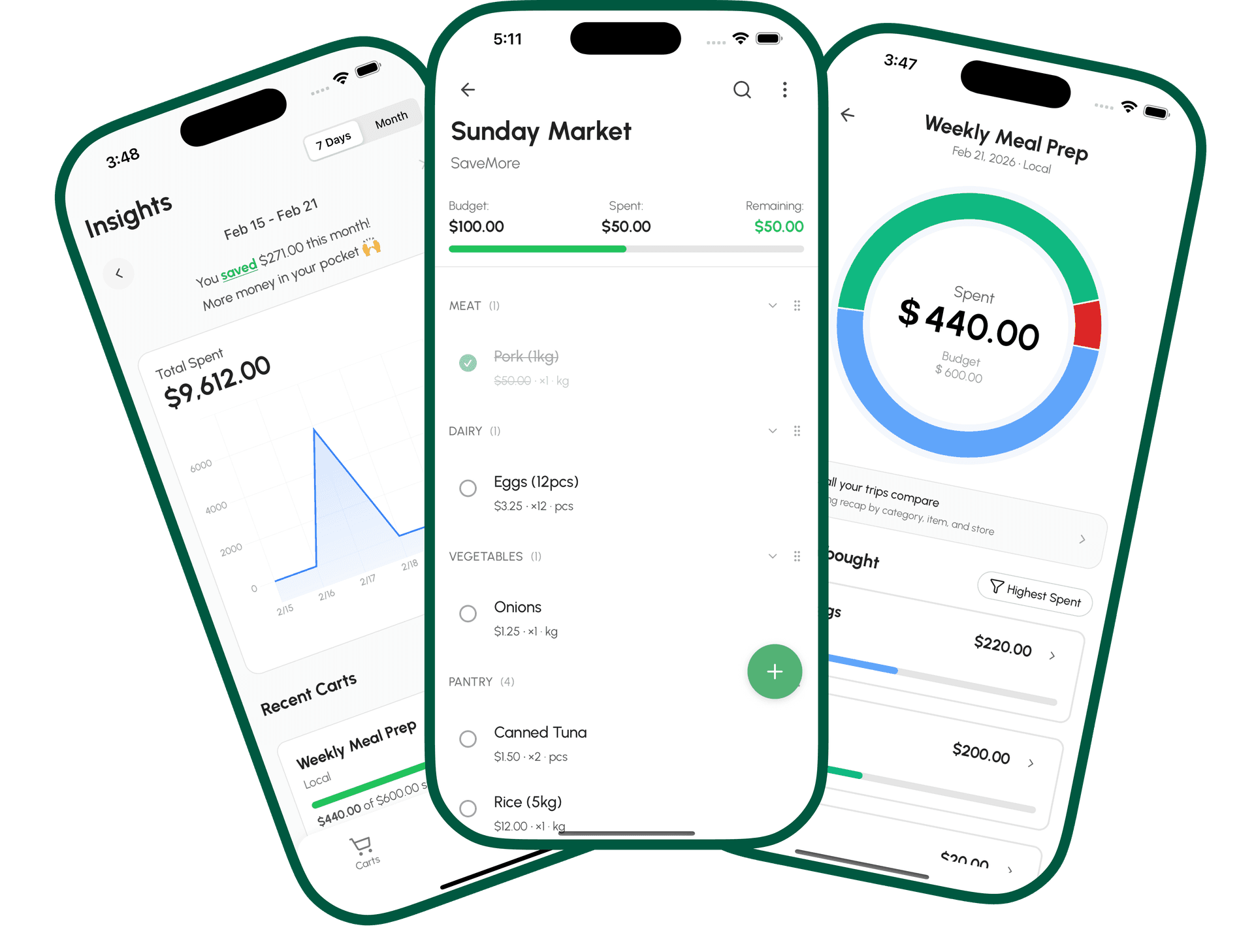
GroceryBudget starts with the budget, not the list. Every cart has a store and a spending limit. The list lives inside that financial constraint.
No ads, ever. The free tier has feature limits, not ad interruptions. You can use the app without any degraded experience.
Real-time budget bar. Set your limit before you go in. Add items with prices as you shop. The bar shows how much of your budget you've used and how much remains. When you're getting close, you know — before you reach the register.
Price memory across stores. Every price you enter gets saved against that item and store. Next trip, you get a suggestion based on what you paid last time. Add 20 regular items in under a minute because the prices are already filled in.
Smart Add for fast entry. Tap the mic and say "2 lbs chicken breast $5.49" — the app parses the name, quantity, and price. Or point your camera at a product label. Voice runs on-device and works offline; AI camera scanning reads the label with AI on a server, so it needs a connection. Voice dictation is free and unlimited; camera scanning includes 3 free scans, then Premium unlocks unlimited.
Spending insights over time. Every completed cart feeds into your Insights tab. You can see how much you spent by category (Produce, Meat, Dairy, etc.), by store, and across weeks or months. Free users get 7 days of history; Premium unlocks your full history.
No account required. Open the app and create your first cart immediately. No signup, no email, no password. When you eventually create an account, your data — carts, prices, history — all transfers automatically.
Offline. Works completely without internet. Grocery stores have notoriously poor cell coverage and unreliable Wi-Fi. Your tracking doesn't depend on a connection.
Stop guessing what your groceries cost
Free to use. Works offline, no account needed.
Pricing Comparison
Listonic Premium (to remove ads and unlock features) runs around $2.99-4.99/mo depending on the plan.
GroceryBudget's free tier is genuinely ad-free and covers everything most shoppers need. Premium is $9.99/mo, $29.99/yr, or $79.99 for lifetime access. Premium adds unlimited AI label and receipt scanning (free users get 3 free scans of each), recurring lists, full spending history, the full most-purchased items list, and Family Sharing for up to 5 members.
If you were already paying for Listonic just to remove ads, GroceryBudget's premium gives you the same clean experience plus budget tracking for a similar cost.
Feature Comparison
| Feature | Listonic | GroceryBudget |
|---|---|---|
| Shared lists | Yes (premium) | Yes (Family Sharing, Premium) |
| Ad-free experience | Paid only | Always |
| Per-trip budget | No | Yes |
| Running total while shopping | No | Yes |
| Price memory | No | Yes |
| Voice/camera input | No | Yes (Smart Add) |
| Spending insights | No | Yes |
| Price history | No | Yes (Premium) |
| Store comparison | No | Yes (Premium) |
| Offline support | Yes | Yes |
| No account required | No | Yes |
Making the Switch
Switching apps mid-habit is friction. The first trip with any new app takes longer than you'd like — you're learning the interface and entering prices for the first time.
But after that first trip, price memory kicks in. By the third trip, your regular items auto-fill with suggested prices. Save a cart as a template and your setup time drops to near zero.
The ads you won't see are an immediate improvement. The budget tracking compounds over time. After a month of real data, you'll know exactly where your grocery money goes — something Listonic never could have told you.
For the full breakdown of how these two apps compare, see GroceryBudget vs Listonic.
Also switching from another app? See the best Bring! alternative and best AnyList alternative guides.
Download GroceryBudget — no account needed to start.