You Can't Control Grocery Prices. Here's What You Can.
Someone told us tracking grocery prices is pointless because you can't change them. They're half right. Here's what the data actually says.
Key Takeaways
• Why tracking grocery spending works even when prices are rising.
• Specific ways budget awareness leads to real savings.
• How to use price data to make smarter shopping decisions.
Track your grocery spending as you shop
Free to use. Works offline, no account needed.


Someone left a comment a few weeks ago that stuck with us: "Why bother tracking grocery prices when you can't do anything about them?"
It's a fair point. You can't call up your local supermarket and negotiate the price of eggs. You can't vote away tariffs at the checkout counter. You can't do anything about the Iran war driving up diesel and fertilizer costs, or the supply chain disruptions rippling through every grocery aisle in the country.
They're right about all of that. But they're wrong about the conclusion.
The Part They're Right About
Grocery prices in 2026 are up 2.4-3.1% year over year, depending on the category. The Yale Budget Lab estimates that tariffs alone are costing the average American household $1,681 per year in higher prices across all goods. Seventy-three percent of Americans say they're worried about grocery affordability — and they should be, because the average household is now spending $1,546 per month on food.
You didn't cause any of this. You can't fix it. If you're frustrated about it, that frustration is completely justified.
But here's the thing: the people who track their grocery spending consistently spend roughly $200 less per month than people who don't. Not because prices magically dropped for them. Because their behavior changed.
That $200 isn't a made-up number. It shows up repeatedly in consumer spending research, and we see the same pattern in our own data from GroceryBudget users. The savings come from five specific places — none of which require prices to go down.
Where You Shop Matters More Than You Think
The same gallon of milk can vary by $1.50 or more between stores in the same neighborhood. Multiply that across the 15-20 staples you buy every week, and store choice alone can swing your monthly spending by $80-120.
Most people don't make this comparison because they don't have the data. You have a vague sense that Store A is "about the same" as Store B. But vague senses are usually wrong. When you track prices across stores over time — which GroceryBudget's price memory does automatically — actual patterns emerge. Maybe your regular store is cheaper on produce but 20% more expensive on dairy. That's actionable information.
You don't need to become a deal-hunter visiting six stores. Even shifting two or three high-volume purchases to a cheaper option makes a measurable difference.
Unplanned Trips Are Budget Killers
We wrote about this after tracking our own spending for 90 days: the quick stops — "just need milk and bread" — accounted for 31% of total grocery spending. These trips don't feel like real shopping, so they don't trigger the same mental budget discipline. You walk in for one thing and walk out with a bag.
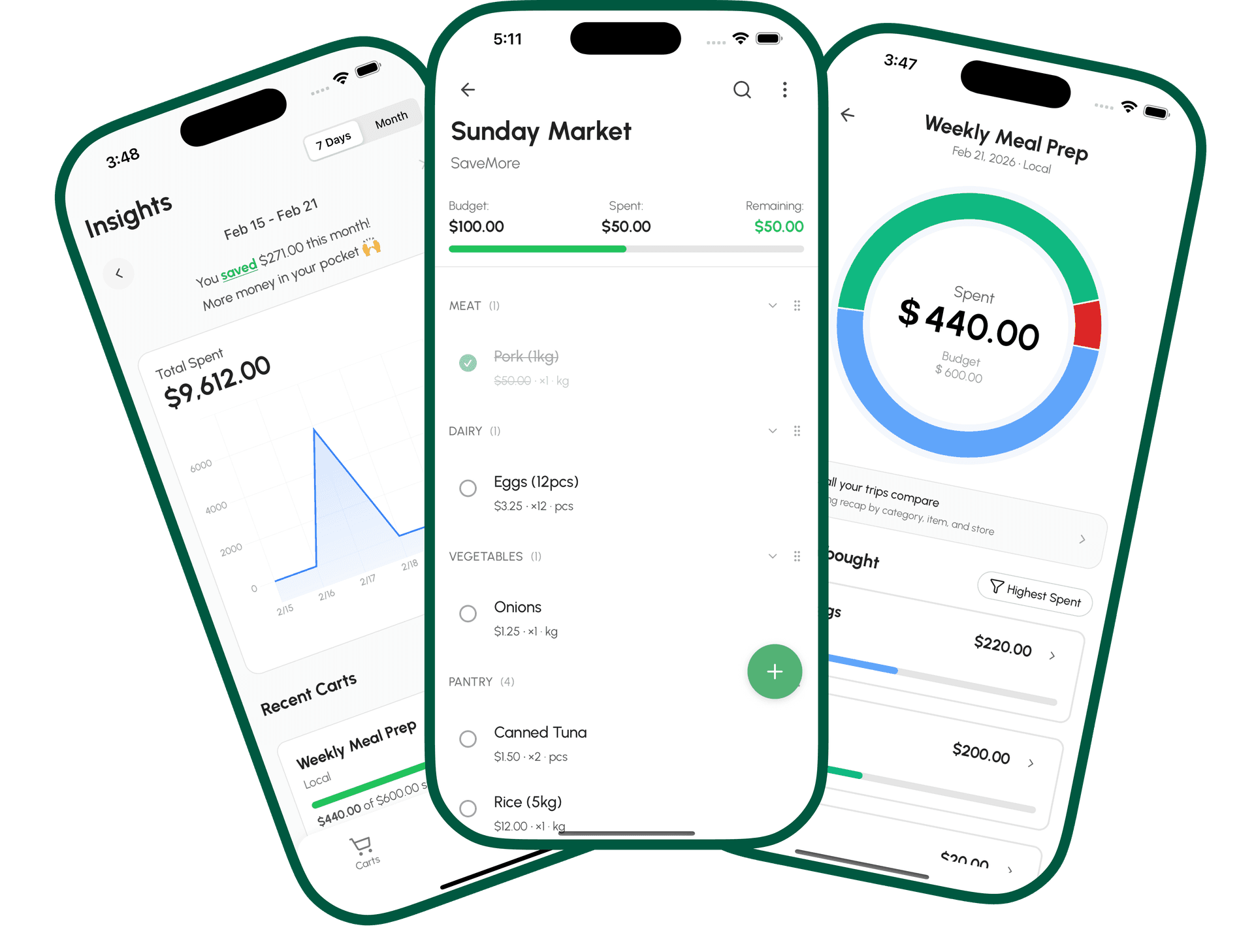
This is an impulse buying problem dressed up as a convenience problem. And it's invisible without data. When you create a cart for every trip, even the quick ones, you see exactly how much those "small" stops are adding up. GroceryBudget's spending insights break this down clearly — total spending from planned trips versus unplanned ones.
Cutting unplanned trips in half doesn't require willpower. It requires a list on your phone that you check before leaving the house. If you already have the milk, you don't make the trip. If you do make the trip, you track it, so you can't pretend it didn't happen.
You're Probably Wasting 30-40% of What You Buy
The USDA estimates that the average American household wastes 30-40% of the food it purchases. That's not a typo. Nearly a third of your grocery spending ends up in the trash — expired produce, forgotten leftovers, duplicates of things you already had in the pantry.
At $1,546/month in average food spending, 30% waste means roughly $460/month going straight to the garbage. Even cutting waste by a third saves over $150/month.
Tracking what you buy forces a confrontation with this. When you see that you've purchased lettuce four weeks in a row but keep throwing half of it away, you either buy less or you eat it. Both save money. Budget alerts in GroceryBudget flag when a category is trending higher than usual, which often surfaces exactly this kind of pattern.
Stop guessing what your groceries cost
Free to use. Works offline, no account needed.
Price Creep Is Real and You're Not Noticing It
Eggs went from $2.50 to $3.80 at most stores over the past year. Did you notice the increase, or did you just keep buying eggs? Most people keep buying. The price increase is small enough per trip that it doesn't register, but across a year it's a significant budget hit.
This is true across dozens of items. A quarter here, fifty cents there. Individually invisible, collectively expensive.
When you have price history for your regular purchases, you see exactly when something jumped. That doesn't mean you stop buying eggs — but it might mean you check a different store, buy a different size, or notice that the "sale" price this week is what the regular price was three months ago. GroceryBudget records price history per item per store, so these shifts are visible instead of silent.
Some Categories Are Rising Faster Than Others
Not all grocery inflation is equal. In 2026, beef is projected to increase 6.7% while fresh vegetables are up only 1.4%. Dairy is climbing faster than grains. Processed foods are outpacing whole ingredients.
If you're not paying attention to category-level trends, you're absorbing uneven price increases without adjusting. Someone spending $300/month on beef-heavy meals is getting hit much harder than someone spending the same amount on a vegetable-forward diet.
This isn't about telling you what to eat. It's about knowing where your money is going so you can decide whether to absorb the increase or shift. Maybe you do one more chicken night and one fewer steak night. Maybe you buy the store brand instead of the national brand in the categories where prices jumped most. These are small adjustments, but they compound.
What to Do This Week
You don't need an overhaul. You need information. Here's a starting point:
Track every trip. Not just the big Saturday run — every stop. Create a cart, add items as you go, review after. Do this for two weeks before making any changes.
Check your top 10 staples at a second store. Pick the items you buy literally every week and compare prices. You'll probably find 3-4 items where switching stores saves real money.
Look at what you're throwing away. Before your next trip, open the fridge and be honest about what's going to expire before you eat it. Adjust your list accordingly.
Review your spending by category. If you've been tracking for a few weeks, look at where the money is actually going. The categories that surprise you are the ones worth paying attention to.
Set a budget alert. Pick a weekly or monthly number and get notified when you're approaching it. The awareness alone changes behavior — not dramatically, but consistently.
The Real Point
You can't control grocery prices. You can't control inflation, tariffs, or geopolitics. The person who left that comment was right about all of it.
But you can control where you shop, how often you make unplanned trips, how much food you waste, and whether you notice when prices shift. Those things are worth hundreds of dollars a month — and none of them require a single price to drop.
Tracking doesn't lower prices. It changes what you do about them. That's the part worth paying attention to.