What Percentage of Income Should Go to Groceries? (2026)
The rule of thumb is 10-15% of take-home pay, but what's realistic shifts a lot by salary. Benchmarks for $40k, $80k, and $120k+ incomes, and when to ignore the percentage entirely.
Key Takeaways
• How much of your income should go to groceries at different salary levels.
• Why percentage-based budgeting works better than flat numbers.
• Practical adjustments based on household size and location.
Track your grocery spending as you shop
Free to use. Works offline, no account needed.


The Percentage Problem
Most budgeting advice says to spend 10-15% of your income on food, including groceries and eating out. That's the standard recommendation from financial planners.
But 10% of $40,000 is $4,000/year ($333/month). 10% of $120,000 is $12,000/year ($1,000/month). Those are vastly different lifestyles. The percentage rule gives you a starting point, but it needs context.
Here's a more realistic breakdown.
Grocery Spending by Income Level
These numbers assume groceries only (not restaurants or takeout) for a single adult. Scale up for your household.
| Annual Income | Recommended % | Monthly Grocery Budget | Weekly Budget |
|---|---|---|---|
| $30,000 | 12-15% | $300-$375 | $70-$87 |
| $40,000 | 10-13% | $333-$433 | $77-$100 |
| $50,000 | 9-12% | $375-$500 | $87-$116 |
| $60,000 | 8-11% | $400-$550 | $93-$128 |
| $75,000 | 7-10% | $438-$625 | $101-$145 |
| $100,000 | 6-9% | $500-$750 | $116-$174 |
| $150,000+ | 5-8% | $625-$1,000 | $145-$232 |
Key insight: The percentage goes down as income goes up. Someone earning $30,000 might need 13% of their income for groceries. Someone earning $150,000 doesn't need to spend 13% ($1,625/month) to eat well. Their spending on groceries rises in absolute dollars but drops as a percentage of income.
How Much of Your Budget Should Go to Food?
If you want one number: 10-15% of take-home pay for all food, groceries plus eating out. Groceries alone usually land at 6-10%.
Treat that as a starting reference, not a target to hit. Two things override it:
- Household size. A family of five cannot hit 10% on a median income, and should not try. Check the dollar amount against USDA benchmarks for your household size before trusting any percentage.
- Income level. The percentage is most useful in the middle of the range and least useful at both ends, for opposite reasons covered below.
If you want the absolute dollar figure rather than a percentage, see average cost of groceries per month.
Why Income-Based Budgeting Works
It's proportional to your constraints
A flat "spend $400/month on groceries" recommendation ignores that $400 is 16% of a $30K salary and 4% of a $120K salary. The person earning $30K has to make very different choices than the person earning $120K.
It scales with your household
If you earn $60,000 and feed a family of four, your grocery percentage will naturally be higher (12-16%) than if you're single (8-11%). That's expected. The income-based approach makes room for this.
It accounts for trade-offs
At lower incomes, groceries compete with rent, transportation, and debt payments. The percentage framework helps you see when grocery spending is crowding out other essentials, or when you have room to spend more on quality food.
Stop guessing what your groceries cost
Free to use. Works offline, no account needed.
Adjusting for Your Situation
Household Size Multipliers
The table above is for one person. Multiply using these rough factors:
| Household | Multiplier |
|---|---|
| Single adult | 1.0x |
| Couple | 1.8x |
| Family of 3 | 2.3x |
| Family of 4 | 2.7x |
| Family of 5 | 3.2x |
Example: You earn $60,000 and have a family of 4. Single-person budget at 10%: $500/month. Family multiplier: $500 x 2.7 = $1,350/month. That's 27% of your income, which is high. You'd want to target the lower end of the range or find ways to reduce per-person costs through bulk buying and meal planning.
Location Adjustments
- High-cost cities (NYC, SF, LA, Boston): Add 15-25% to base numbers
- Average-cost areas (Chicago, Denver, Atlanta): Use base numbers
- Low-cost areas (rural Midwest, parts of the South): Subtract 10-15%
Dual-Income Households
Use your combined household income for the calculation. A couple earning $50K and $60K combined ($110K) should use the $100K+ row, not two separate $50-60K calculations. You share meals, buy in bulk, and split costs.
Where People Go Wrong
Comparing to national averages. The BLS says the average American household spends about $6,000/year on groceries. But "average" includes single people and families of six, cities and rural towns, organic shoppers and extreme couponers. The average is meaningless for your specific situation.
Ignoring total food spend. Your grocery budget means nothing if you're also spending $400/month on restaurants and takeout. Track all food spending together, then decide how to split it between groceries and eating out.
Not adjusting for life changes. Got a raise? Had a kid? Moved to a more expensive city? Your grocery budget should change too. Review it when your income or situation changes.
Setting the budget too tight. If you're at 15% of income on groceries and you cut to 8% overnight, you'll feel deprived and quit. Cut gradually. A 1-2% reduction per month is sustainable.
A Practical Framework
Step 1: Calculate your after-tax monthly income. This is your take-home pay, not your salary. If you earn $60,000, your take-home is roughly $3,800-$4,200/month depending on your state and deductions.
Step 2: Pick your target percentage. Use the table above as a starting point. For most people, 8-12% of take-home pay on groceries is a comfortable range.
Step 3: Set a weekly budget. Divide your monthly number by 4.3 (average weeks per month). A $450/month budget becomes about $105/week. That's the number you take to the store.
Step 4: Track every trip. The difference between people who stay on budget and people who don't isn't discipline. It's visibility. When you can see exactly how much you're spending in real time, you make better decisions.
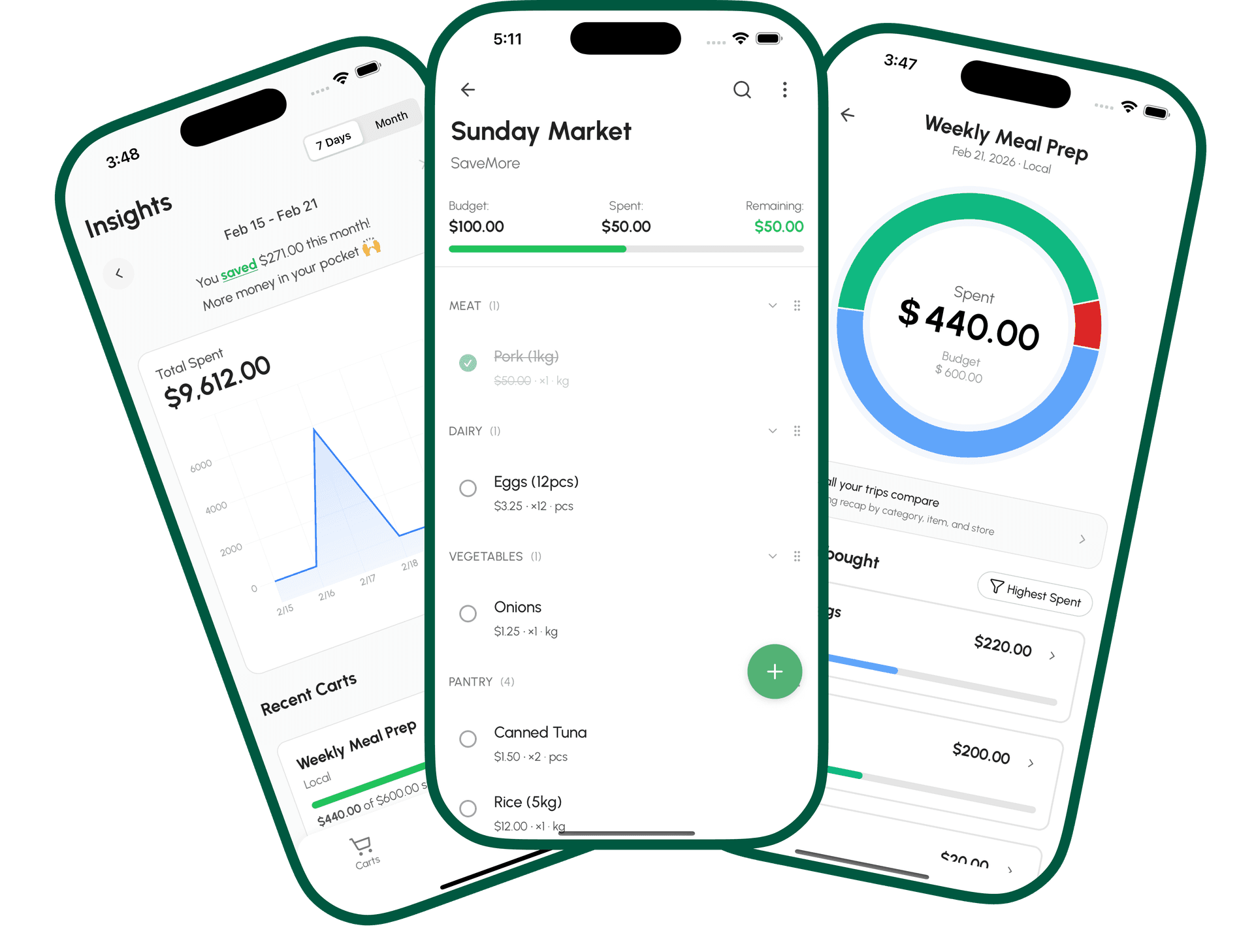
GroceryBudget makes this easy. Set your budget per trip, add items as you shop, and see your remaining budget update in real time. Over time, your spending insights show whether you're trending up or down, so you can adjust before small overages become big ones.
The Bottom Line
There's no single "right" number for a grocery budget. It depends on your income, household size, location, and eating habits. But the income-based approach gives you a proportional target that makes sense for your financial situation.
Pick your percentage. Calculate your weekly number. Track your next trip. Adjust from there. The goal isn't perfection. It's knowing where you stand so you can make informed choices.
---
Related: How much to spend on groceries per month in 2026 — USDA benchmarks by household size. Grocery budget for couples — shared budgeting tips for two. Average grocery cost for a family of 3 — why three-person households often overspend. And best grocery budget apps 2026 to track your spending automatically.
Frequently Asked Questions
What percentage of income should go to groceries?+
The common guideline is 10 to 15 percent of take-home pay on food, covering both groceries and eating out. It holds up reasonably well in the middle of the income range, but breaks down at the edges: lower-income households routinely spend 25 to 35 percent because food costs have a floor, and high earners often land under 6 percent without trying.
How much of my budget should go to food?+
Budget 10 to 15 percent of take-home pay for all food if your income is near the US median. Below roughly $40k, expect 20 percent or more and treat that as normal rather than a failure. Above roughly $120k the percentage stops being a useful target, because it would allow far more than you need.
Is 10% of income enough for groceries?+
It depends far more on household size and location than on income. Ten percent of a $90,000 salary is comfortable for a couple in a low cost-of-living area and tight for a family of five in a major metro. Check the dollar figure against USDA benchmarks for your household size before trusting the percentage.
What percentage of income do most Americans spend on groceries?+
Roughly 6 to 8 percent of disposable income on groceries specifically, plus a similar amount on food away from home, though the range is wide. The lowest income quintile spends around a third of income on food, while the highest spends under 8 percent.