Grocery Budget Calculator: Your Weekly Spending
Most people guess their grocery budget. Here's how to calculate a number that's actually realistic for your household, eating habits, and location.
Key Takeaways
• A step-by-step method for calculating your realistic grocery budget.
• USDA benchmarks adjusted for household size and location.
• How to track and refine your budget over time.
Track your grocery spending as you shop
Free to use. Works offline, no account needed.


Why Most Grocery Budgets Fail
People set grocery budgets one of two ways. They either pick a round number that sounds reasonable ("$400 a month should be fine") or they Google "average grocery budget" and use whatever number comes up.
Both approaches miss the point. Your grocery budget depends on where you live, how many people you feed, what you eat, and how often you eat out. A $400 monthly budget might be generous for a single person in rural Iowa and completely unrealistic for a family of three in Seattle.
Here's how to calculate a number that works for you.
Step 1: Start With the USDA Baseline
The USDA publishes monthly food cost estimates at four spending levels. These are the closest thing to a national benchmark for grocery spending.
Single Adult (age 20-50)
| Plan | Monthly | Weekly |
|---|---|---|
| Thrifty | $260 | $60 |
| Low-Cost | $320 | $74 |
| Moderate | $375 | $87 |
| Liberal | $450 | $104 |
Couple (two adults, 20-50)
| Plan | Monthly | Weekly |
|---|---|---|
| Thrifty | $480 | $111 |
| Low-Cost | $590 | $137 |
| Moderate | $700 | $162 |
| Liberal | $850 | $197 |
Family of 4 (two adults, two children 6-11)
| Plan | Monthly | Weekly |
|---|---|---|
| Thrifty | $780 | $181 |
| Low-Cost | $970 | $225 |
| Moderate | $1,130 | $262 |
| Liberal | $1,350 | $313 |
Most households fall somewhere between Low-Cost and Moderate. If you're not sure which tier fits, start with Low-Cost and adjust from there.
Step 2: Adjust for Your Location
The USDA numbers are national averages. Where you live changes things significantly.
High-cost areas (add 15-25%): San Francisco, New York City, Boston, Honolulu, Los Angeles, Seattle, Washington D.C.
Moderate-cost areas (use as-is): Chicago, Denver, Atlanta, Dallas, Phoenix, Philadelphia.
Lower-cost areas (subtract 10-15%): Rural Midwest, parts of the South, smaller cities in Texas, Ohio, Indiana.
So a couple on the Low-Cost plan ($590/month nationally) in San Francisco should budget around $680-$740/month. The same couple in rural Indiana might need only $500-$530.
Stop guessing what your groceries cost
Free to use. Works offline, no account needed.
Step 3: Factor In Your Eating Habits
The USDA assumes you cook most meals at home. Adjust for reality:
Eat out 2-3 times a week? Reduce your grocery budget by 15-20%. Your total food spend stays the same, but more goes to restaurants.
Meal prep on Sundays? You'll likely spend 10-15% less on groceries because you waste less food and make fewer impulse purchases during the week.
Dietary preferences? Vegetarian and vegan diets typically cost 5-15% less than omnivore diets. Keto, paleo, and organic diets cost 15-30% more.
Buy mostly name brands? Add 10-20% compared to store brands. The price difference on a full cart of groceries is real.
Step 4: Calculate Your Number
Here's the formula:
USDA baseline for your household x location adjustment x eating habit adjustment = your monthly grocery budget
Example: A couple in Denver who eats out twice a week.
- USDA Low-Cost for a couple: $590
- Location: moderate (no adjustment): $590
- Eats out 2x/week (reduce 15%): $590 x 0.85 = $501/month
- Weekly: $125/week
Example: A single person in New York who eats mostly organic.
- USDA Low-Cost for single adult: $320
- Location: high-cost (add 20%): $320 x 1.20 = $384
- Organic preference (add 20%): $384 x 1.20 = $461/month
- Weekly: $115/week
Step 5: Test It
Your calculated number is a starting point, not a final answer. Here's how to refine it:
Track your actual spending for 4 weeks. Don't try to hit the target yet. Just track what you normally spend. If your calculated budget is $125/week and you're actually spending $160, a $125 target will feel impossible.
Close the gap gradually. If there's a big difference between your calculated budget and actual spending, aim to close 25% of the gap each month. Spending $160 but want to hit $125? Target $150 for the first month, $140 the next, and work your way down.
Review monthly. Grocery prices change. Seasons change. Your eating habits change. Check your budget against reality every month and adjust.
The Running Total Advantage
The biggest reason grocery budgets fail isn't bad math. It's that people don't track spending during the trip.
You set a $100 budget for the week. You grab items off your list. You add a few extras. You get to checkout and it's $127. Now you either put things back (awkward) or just pay it (over budget again).
The fix is seeing your running total as you shop. When you can see that you're at $83 with five items left, you make different decisions than when you're guessing.
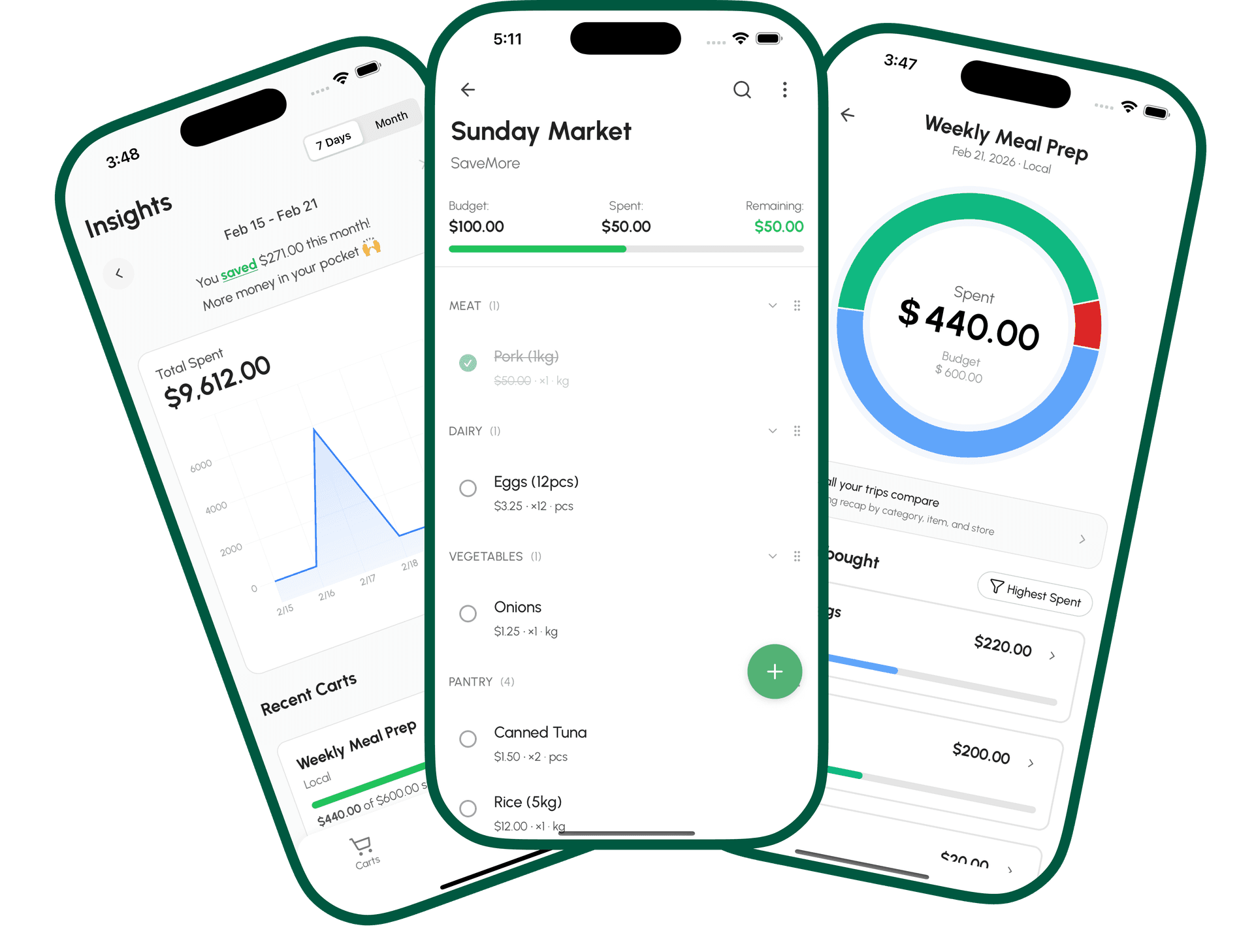
GroceryBudget does this automatically. Set your budget when you create a cart. Add items and prices as you shop. The app shows your budget, spent, and remaining in real time. You always know exactly where you stand.
Quick Reference Table
| Household | Low Budget | Moderate Budget | Notes |
|---|---|---|---|
| Single adult | $250-$320/mo | $350-$400/mo | Add 15-25% for high-cost cities |
| Couple | $480-$590/mo | $700-$850/mo | Reduce 15% if eating out 2x/week |
| Family of 3 | $650-$800/mo | $900-$1,050/mo | Kids under 6 cost less |
| Family of 4 | $780-$970/mo | $1,130-$1,350/mo | Teens cost more than USDA estimates |
| Family of 5+ | $950-$1,200/mo | $1,400-$1,700/mo | Bulk buying helps at this size |
Start Today
Pick your household size from the table above. Adjust for location and habits. Set that as your per-trip budget. Track your next grocery run in real time. One trip with real data beats a month of guessing.