Grocery Budget for One Person: What's Realistic?
Living solo doesn't mean your grocery budget should be a mystery. Here's how to figure out what's realistic, where people overspend, and how to stay on track.
Key Takeaways
• Realistic grocery spending benchmarks for a single person in 2026.
• Why solo shoppers tend to overspend and how to fix it.
• A simple framework for setting and sticking to your grocery budget.
Track your grocery spending as you shop
Free to use. Works offline, no account needed.


The Solo Grocery Problem
Budgeting groceries for one person should be simpler than budgeting for a family. Fewer mouths, fewer variables.
But in practice, single-person households spend more per person on groceries than families. The USDA's data backs this up. A single adult on the "moderate" plan spends about $350-$400/month. A family of four on the same plan spends $1,000-$1,100 total, which is roughly $250-$275 per person.
Why? Because cooking for one creates waste, portion sizes at stores are designed for families, and there's no one else keeping your spending in check.
What People Actually Spend
Here are the USDA's 2026 food plan estimates for a single adult (age 20-50):
| Plan | Monthly Cost | Weekly Cost |
|---|---|---|
| Thrifty | $250-$280 | $58-$65 |
| Low-Cost | $300-$340 | $70-$79 |
| Moderate | $350-$400 | $81-$93 |
| Liberal | $420-$470 | $98-$109 |
These are national averages. If you live in a high-cost city like San Francisco, New York, or Boston, add 15-25% to these numbers. In lower-cost areas in the Midwest or South, you might be 10-15% below.
Where Solo Shoppers Overspend
Convenience foods. When you're cooking for one, the temptation to buy pre-made meals, deli items, and frozen dinners is strong. A $6 frozen meal every night is $180/month just on dinners.
Produce waste. You buy a bag of spinach, use a third of it, and throw the rest away. A head of lettuce goes brown before you finish it. This adds up to $30-$50/month in wasted food for the average single-person household.
No bulk advantage. Families buy the 5-pound chicken breast pack and freeze portions. As a solo shopper, you often buy smaller packages at a higher per-unit price.
Impulse purchases. Shopping alone means no one questions the $8 fancy cheese or the third bag of snacks. Without accountability, the small additions pile up.
How to Set Your Budget
Skip the generic advice. Here's a practical approach:
Step 1: Track what you actually spend. Before setting a budget, track your real spending for 2-3 weeks. Most people's estimate of their grocery spending is 20-30% lower than reality.
Step 2: Pick your tier. Look at the USDA table above. Most single adults land comfortably in the Low-Cost to Moderate range ($300-$400/month). If you eat out frequently, your grocery number will be lower but your total food spend might be higher.
Step 3: Set a per-trip budget. A monthly budget is too abstract. If you shop once a week, divide by 4. If your monthly target is $320, that's $80 per trip. That's a number you can actually feel in the store.
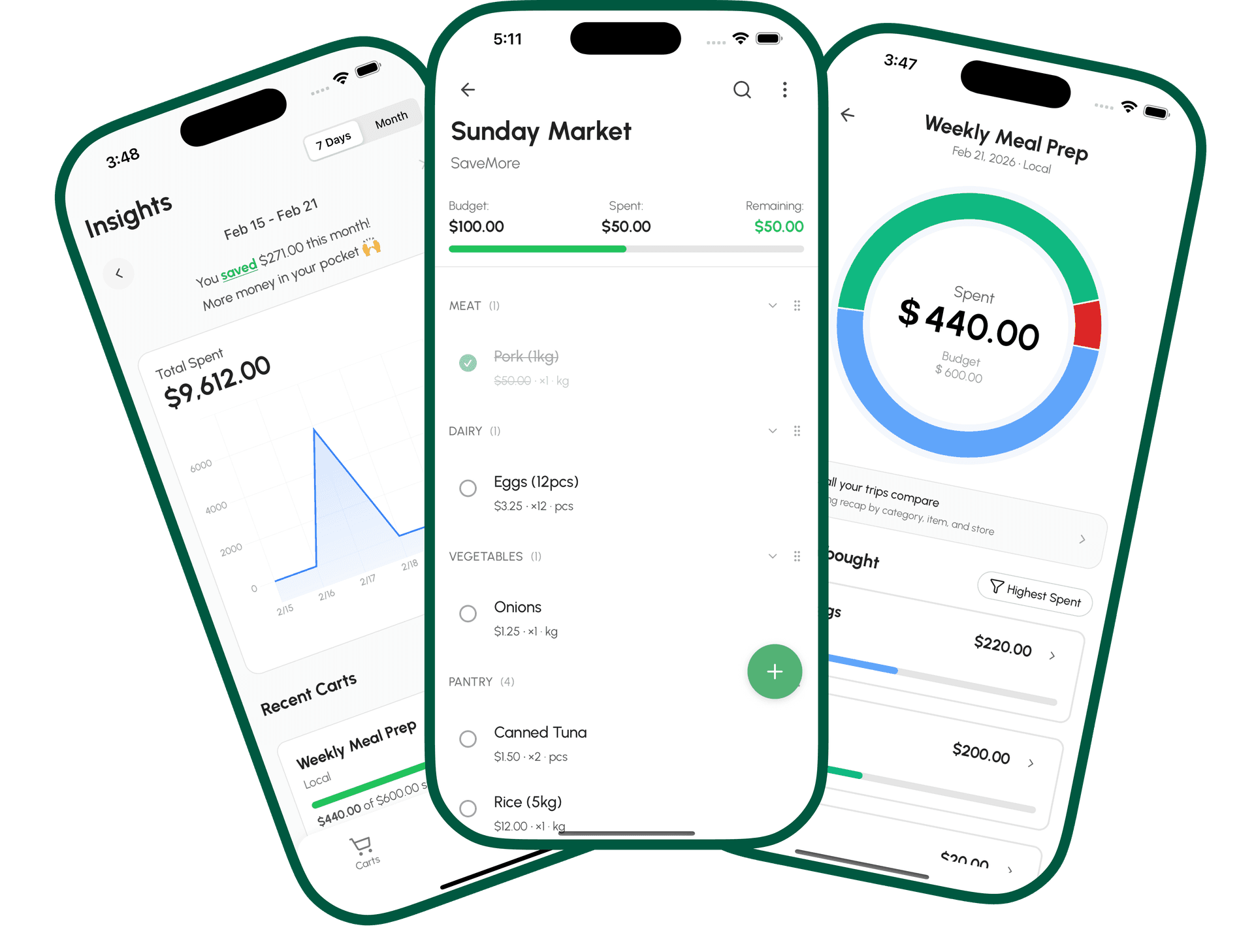
Step 4: Track every trip. This is where most budgets fail. You set a number, forget about it, and check at the end of the month. By then it's too late. Track each trip in real time so you know where you stand before checkout.
Stop guessing what your groceries cost
Free to use. Works offline, no account needed.
Making It Work in the Store
Shop with a list. Not groundbreaking advice, but the key is adding prices to your list. A list without prices is just a memory aid. A list with prices is a budget.
Use the per-unit price. That $3.50 yogurt might be cheaper per ounce than the $2.00 one. Train yourself to check the shelf tag's per-unit price, not just the sticker price.
Buy frozen produce. It's pre-portioned, lasts weeks, and is often cheaper than fresh. Frozen broccoli, spinach, and berries are just as nutritious and generate zero waste.
Cook in batches, freeze in portions. Make a pot of chili, curry, or soup on Sunday. Portion it into containers. You get the bulk-cooking efficiency of a family without the waste.
Shop your pantry first. Before going to the store, check what you already have. Most single-person kitchens have $20-$40 worth of forgotten ingredients that could make a meal.
What a Realistic Week Looks Like
Here's a sample $75/week grocery run for one person:
| Category | Budget | Examples |
|---|---|---|
| Protein | $20 | Chicken thighs, eggs, canned tuna, beans |
| Produce | $15 | Bananas, frozen broccoli, onions, canned tomatoes |
| Grains & Carbs | $12 | Rice, pasta, bread, oats |
| Dairy | $10 | Milk, cheese, yogurt |
| Pantry | $8 | Cooking oil, spices, condiments |
| Snacks & Other | $10 | Coffee, nuts, dark chocolate |
That's $300/month, squarely in the Low-Cost tier. Adjust up or down based on your eating habits and location.
When Your Budget Keeps Breaking
If you consistently go over, the problem is usually one of three things:
You're not tracking in real time. Checking your spending after checkout is an autopsy, not a budget. You need to see the running total as you shop. That's what GroceryBudget is built for. Set a budget, add items as you go, and see exactly how much you have left before you reach the register.
Your budget is unrealistic. If you set a $200/month target when your actual spending is $380, you'll fail every time. Start with a 10% reduction from your current spending. Once that feels normal, cut another 10%.
You're not accounting for non-grocery food. Coffee shops, lunches out, and delivery orders aren't groceries, but they eat into the same food budget. Track all food spending, not just grocery runs.
The Bottom Line
A realistic grocery budget for one person in 2026 is $300-$400/month, depending on where you live and how you eat. The key isn't hitting a perfect number. It's knowing what you spend, setting a target per trip, and tracking in real time so you can adjust before it's too late.
Start with your next grocery run. Set a budget. Track what you add. See where you land. That single data point is worth more than any budgeting spreadsheet you'll never maintain.