Monthly Grocery Budget for One in the Philippines
Living alone in the Philippines? Here's a realistic monthly grocery budget at every income level, with meal examples, an OFW benchmark, and where it goes.
Key Takeaways
• Realistic monthly grocery budgets for solo living at three income levels.
• What a week of meals looks like at each budget tier.
• The single biggest lever for cutting food costs when living alone.
• A benchmark for OFW families budgeting groceries against a fixed monthly remittance.
Put this advice to work on your next grocery trip
Plan your list, set a budget, and track the total while you shop.
Explore GroceryBudget features →

Living alone changes your grocery math. Family budget guides assume you can cook in bulk and share costs — but when it's just you, a bunch of kangkong goes bad before you finish it, and a whole tilapia is too much for one meal. Solo grocery budgeting in the Philippines has its own set of challenges.
Here's what realistic monthly food spending looks like for a single person in 2026, across three income levels.
Budget Tier 1: Tight Budget (₱1,500–₱2,500/month)
Who this is for: Students, entry-level workers, or anyone in a lean period
At this level, your grocery strategy is built entirely around high-yield staples. You're not going hungry — but flexibility is limited.
Weekly grocery spend: ₱375–₱625
What you eat:
- Breakfast: Garlic rice + egg + tuyo (₱25–₱35/day)
- Lunch: Rice + canned sardines or mongo (₱30–₱45/day)
- Dinner: Rice + whatever protein is cheapest that week — chicken feet, pork liempo offcuts, or more mongo (₱40–₱65/day)
Monthly breakdown:
- Rice (10–12kg) → ₱500–₱660
- Eggs (1 flat) → ₱195–₱210
- Canned goods (sardines, tuna, corned beef) → ₱300–₱400
- Dried fish and condiments → ₱150–₱200
- Fresh vegetables (minimal — kangkong, pechay in small amounts) → ₱200–₱300
- Cooking oil, soy sauce, vinegar, garlic, onion → ₱150–₱200
Tips for this tier: Buy dried or canned protein over fresh. Shop palengke for vegetables. Cook rice in larger batches to reduce LPG usage.
Budget Tier 2: Comfortable Budget (₱3,000–₱5,000/month)
Who this is for: Young professionals, people living in urban areas with stable income
At this level, you have room for fresh protein a few times a week and occasional variety.
Weekly grocery spend: ₱750–₱1,250
What you eat:
- More frequent fresh fish and chicken (2–3x per week)
- Wider vegetable variety — ampalaya, sitaw, sayote, tomatoes
- Some fresh fruit (saging, papaya, dalandan)
- Occasional convenience foods or takeout substitutes (1–2x/week)
Monthly breakdown:
- Rice (10kg) → ₱500–₱600
- Fresh meat/fish (chicken, bangus, tilapia) → ₱800–₱1,200
- Eggs (1 flat) → ₱200
- Canned goods for backup meals → ₱200–₱300
- Fresh vegetables → ₱400–₱600
- Fruit → ₱200–₱300
- Cooking staples (oil, condiments) → ₱200–₱300
- Dairy and snacks → ₱200–₱400
Tips for this tier: Plan 4–5 meals per week, not 21. Account for eating out 2–3 times without guilt — it's cheaper than buying perishables you won't finish.
Budget Tier 3: Comfortable with Flexibility (₱5,000–₱8,000/month)
Who this is for: Mid-career professionals, expats living modestly, or people who prioritize food quality
At this level, you're eating well without restrictions — organic options, better protein cuts, snacks, and more convenience without blowing the budget.
Weekly grocery spend: ₱1,250–₱2,000
This tier allows for imported goods, premium cuts, specialty items, and a fully stocked pantry without stress.
Quick Reference Table
These are grocery-only figures — no restaurant meals, no delivery apps, no sari-sari convenience markups.
| Budget Level | Monthly | Weekly | What It Looks Like |
|---|---|---|---|
| Bare minimum | ₱2,500–₱3,200 | ₱580–₱740 | Rice, eggs, canned goods, occasional fresh veg. Minimal variety. |
| Tight but adequate | ₱3,200–₱4,500 | ₱740–₱1,050 | Palengke for fresh items, supermarket staples. Home-cooked every meal. |
| Comfortable | ₱4,500–₱6,500 | ₱1,050–₱1,510 | Varied diet, some protein variety (chicken, fish, pork). Some convenience items. |
| With some flexibility | ₱6,500–₱8,500 | ₱1,510–₱1,980 | Better cuts, imported items occasionally, dairy, convenience foods. |
The "tight but adequate" range — ₱3,200–₱4,500/month — is where most budget-conscious single adults in Metro Manila land when they're cooking every meal at home and shopping smart. In the provinces, the same diet typically costs 15–25% less.
Put this advice to work on your next grocery trip
Plan your list, set a budget, and track the total while you shop.
Explore GroceryBudget features →Budgeting on an OFW Remittance
For OFW families where one adult is managing groceries at home while the working member is abroad: the ranges above apply to you individually if you live alone. If you're managing for the household, scale up using per-person estimates instead.
A practical benchmark for a single adult managing on a fixed monthly remittance:
- Grocery-only budget: Target 20–30% of the remittance amount for groceries
- ₱15,000/month remittance: ₱3,000–₱4,500 is a reasonable grocery target
- ₱25,000/month remittance: ₱4,500–₱6,500 gives you more variety without stress
The key discipline: track grocery spending separately from the rest of household expenses (utilities, transport, school fees, savings). Without visibility into where the remittance goes, grocery spending tends to expand invisibly.
The Biggest Variable: How Often You Cook
The single biggest determinant of grocery spending for a single adult isn't which store you use — it's how often you eat at home.
- Cook every meal: ₱3,200–₱4,500/month on groceries is achievable
- Cook 2 meals/day, eat out once: Add ₱1,500–₱3,000/month in food spending
- Cook only sometimes: Grocery budget drops but total food spend goes up significantly
Sari-sari store convenience and delivery app usage are the main ways single adults without time or cooking skills overspend on food. The per-meal cost of a ₱50 pancit canton sachet from a sari-sari store is 3–4x what it costs to make at home.
Where to Shop on a Tight Budget
Palengke first for fresh items. Produce, pork, chicken, and fish are consistently cheaper at wet markets than any supermarket. The gap is typically 20–40% for meat and 15–30% for vegetables.
Puregold or Save More for packaged goods. For rice (in 5kg bags), cooking oil, condiments, canned goods, and instant noodles — Puregold tends to be cheapest on bulk quantities, Save More on smaller sizes. See the Puregold vs Save More comparison for a detailed breakdown.
SM Bonus or Robinsons Selections house brands. For staples where you don't have brand loyalty — cooking oil, canned tomatoes, soy sauce — the supermarket house brands are typically ₱10–₱20 cheaper per unit than national brands with identical ingredients.
Avoid convenience purchases. The markup on 7-Eleven, sari-sari, and mini-marts over supermarket prices on the same item is typically 20–40%.
The Solo Living Problem: Portion Sizes and Waste
The biggest budget killer for solo living isn't price — it's waste. When you buy for one, you often have to buy quantities designed for families. Half a head of cabbage goes bad. You cook too much rice. You buy a kilo of tomatoes and use three.
Practical fixes:
- Buy protein at the palengke where vendors will sell you exactly 200g of chicken breast, not a minimum 500g package
- Cook rice in exact portions — 1 cup dry rice makes roughly 2 cups cooked, which is 1–2 meals for one person
- Use canned goods as protein insurance — they don't spoil and prevent the "I have nothing to eat" emergency delivery order
- Shop 2–3x per week for fresh items rather than one big weekly shop — reduces spoilage significantly for a single person
Tracking What You Actually Spend
Most solo budgets fail not because the number is wrong, but because there's no visibility into where the money goes. A few palengke trips, a couple of convenience store runs, and two Grab Food orders add up fast.
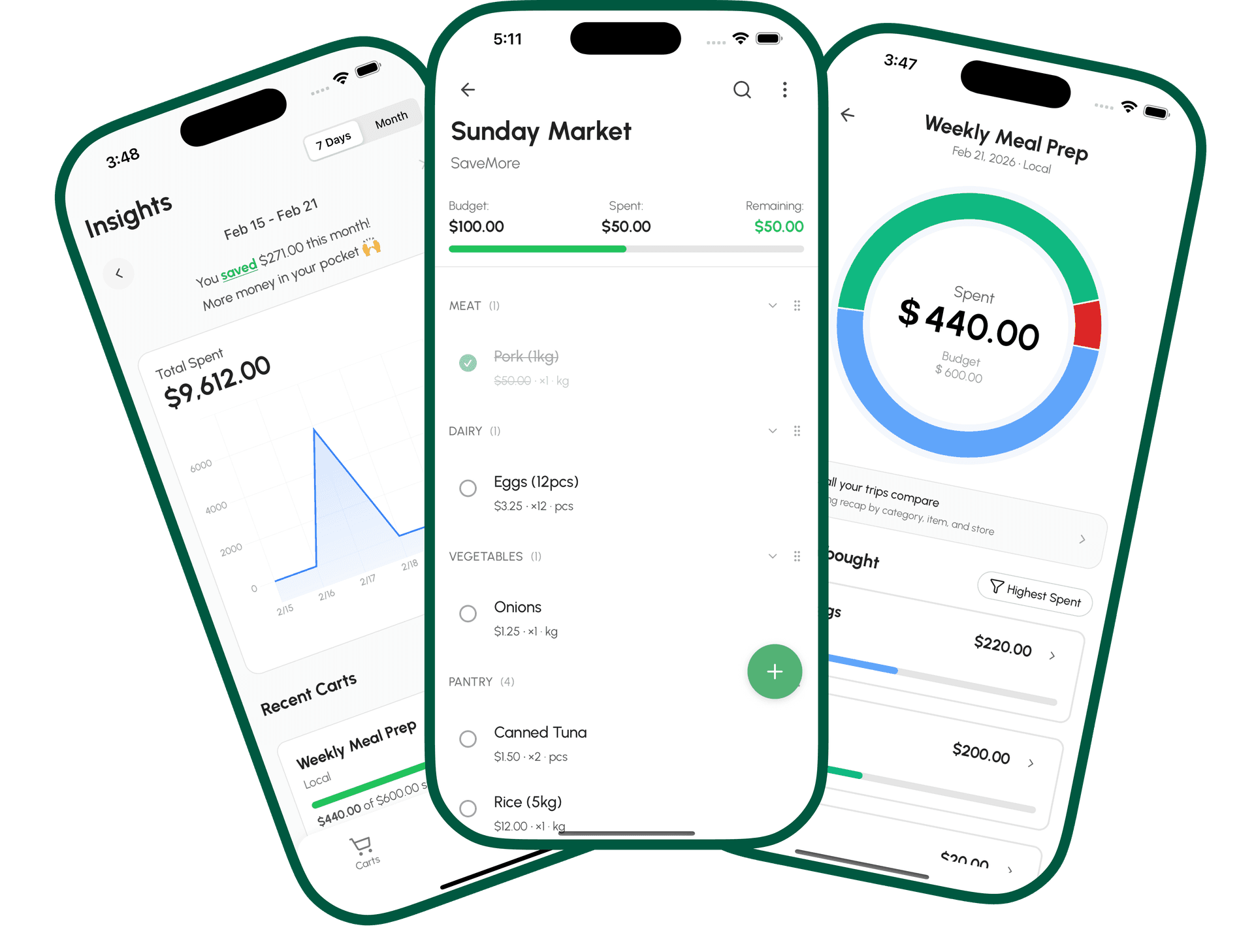
The grocery budget app works for single-person households — set a monthly grocery budget, create a cart each time you shop (palengke or supermarket), and your running total is always visible. Free to start, works offline, no account required.
Frequently Asked Questions
How much should one person spend on groceries per month in the Philippines?+
Realistically ₱1,500–₱2,500 on a tight budget, with comfortable solo budgets running ₱3,000–₱8,000 depending on how much you cook versus eat out.
Can you eat on ₱3,000 a month in the Philippines?+
Yes, with planning — rice, eggs, canned fish, vegetables, and cheaper proteins like monggo and chicken. It takes palengke shopping and cooking from scratch.
What is the cheapest way to eat as a single person in the Philippines?+
Cook in batches, buy rice and staples in bulk, shop fresh goods at the palengke, and limit convenience-store and delivery spending.