How to Make a Grocery List With Prices (And Stay on Budget)
A grocery list without prices is just a memory aid. Here's how to build a list that actually keeps your spending in check.
Key Takeaways
• Why adding prices to your grocery list changes your spending behavior.
• A practical method for building priced lists without extra effort.
• How price memory helps you catch price increases automatically.
Track your grocery spending as you shop
Free to use. Works offline, no account needed.


The Problem With Most Grocery Lists
You write "milk, eggs, bread, chicken, vegetables" on a note. You go to the store. You buy those things plus 15 other items you didn't plan for. You spend $120 on what you thought would be a $60 trip.
The list did its job. You didn't forget the milk. But it didn't do the job you actually needed: keeping your spending under control.
A grocery list without prices is a shopping reminder. A grocery list with prices is a budget.
Why Prices Change Everything
When you add estimated prices next to each item, three things happen:
You see the total before you shop. Adding up your list at home and seeing $95 when your budget is $75 forces you to make trade-offs before you're standing in the aisle with the item in your hand.
You notice what's expensive. Writing "$7.49" next to almond milk makes you think about whether it's worth it this week. Without the price, it's just another line item.
You catch overspending in real time. As you check items off and see the running total climb, you can adjust. Skip the nice-to-have items. Swap the premium brand for the store brand. Make decisions with full information.
How to Build a Priced List
The Simple Method
Before your next trip:
- Write your items
- Add your best estimate for each price
- Total it up
- Compare to your budget
- Adjust if needed
Your price estimates don't need to be perfect. If you think milk is $4.50 and it's actually $4.29, that's fine. The point is having a rough total so you're not blindsided at checkout.
The Better Method: Use Price Memory
After a few trips, you start remembering what things cost at your usual store. Chicken thighs are about $8. A dozen eggs are $3.50. Rice is $4.
This is price memory, and it's one of the most powerful budgeting tools you can develop. When you know what things normally cost, you immediately notice when a price jumps. That $3.50 carton of eggs is suddenly $4.99? You see it right away.
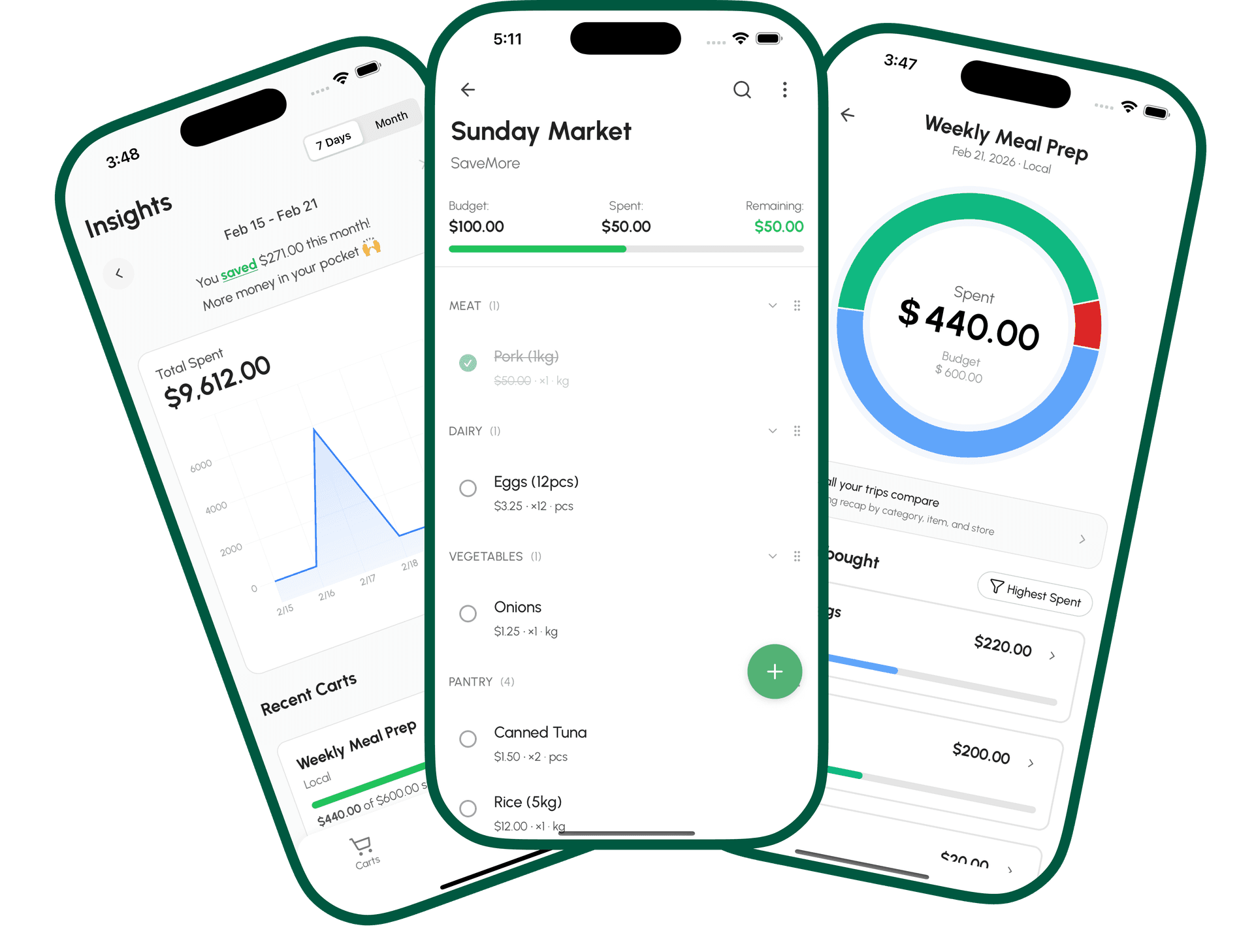
GroceryBudget automates this. It remembers what you paid for each item at each store. When you add an item to your list, it suggests the last recorded price. You build priced lists in seconds instead of guessing.
The Best Method: Templates
If you buy roughly the same groceries every week (most people do), save your list as a template. Next week, load the template, adjust quantities, and you have a priced list ready to go.
No rebuilding from scratch. No forgetting prices. No surprises.
Stop guessing what your groceries cost
Free to use. Works offline, no account needed.
What a Priced List Looks Like
Here's a basic example:
| Item | Est. Price |
|---|---|
| Chicken breast (2 lbs) | $7.00 |
| Eggs (dozen) | $3.50 |
| Milk (gallon) | $4.29 |
| Bread | $3.99 |
| Rice (5 lbs) | $4.49 |
| Bananas | $1.50 |
| Onions (3 lbs) | $2.99 |
| Frozen broccoli | $2.50 |
| Canned tomatoes (2) | $3.00 |
| Pasta | $1.79 |
| Cheese | $4.50 |
| Yogurt (4-pack) | $5.00 |
| Total | $44.55 |
Budget: $50. You have $5.45 of room. That's a clear picture before you leave the house.
Handling Price Surprises
Prices change. That chicken breast you estimated at $7 might be $8.49 this week. Here's how to handle it:
Update as you go. When the actual price differs from your estimate, update it. Your running total stays accurate.
Have a buffer. Set your list total at 85-90% of your budget. The remaining 10-15% absorbs price increases and the occasional unplanned item.
Track price trends. If chicken has been creeping up over the past month, adjust your default estimate. Or switch to thighs, which are usually cheaper per pound.
Common Mistakes
Rounding everything down. People consistently underestimate prices when building lists. If anything, round up. A $3.29 item should be $3.50 on your list, not $3.00.
Forgetting per-unit items. Produce sold by weight is the biggest estimation challenge. "Bananas" could be $1.20 or $3.00 depending on how many you grab. Estimate high.
Not updating prices. If you built a template six months ago, the prices are probably wrong. Update them every few weeks. Or use an app that tracks prices automatically.
Skipping the total. A priced list without a total is just a list with extra numbers. The whole point is seeing how your list stacks up against your budget before you walk into the store.
Making It Stick
The first priced list takes effort. You have to look up or estimate every price. The second one is easier because you remember most of them. By the third or fourth trip, it's second nature.
If you want to skip the manual estimation entirely, GroceryBudget handles it. Add an item, and it fills in the last price you paid at that store. Check items off as you shop, and your running total updates in real time. Set a budget, and you'll see exactly how much you have left before checkout.
The gap between "I think I spent about $80" and "I spent $76.43 and had $3.57 left" is the gap between hoping you stayed on budget and knowing you did.