Single-Person Grocery Budget in the Philippines (2026): What's Realistic on ₱3,000–₱8,000/Month
A realistic grocery budget for one adult in the Philippines depends on where you shop and how you cook. Here are actual benchmarks for different budget levels — from tight ₱3,000/month to comfortable ₱8,000/month — with practical tips for each.
Key Takeaways
• A single adult in the Philippines can eat adequately on ₱3,000–₱4,500/month shopping smart — palengke for fresh items, supermarket for packaged goods.
• The biggest lever is home-cooking frequency: eating out even 3x/week can double your food spend.
• OFW families managing on monthly remittances: a realistic grocery-only budget for one adult ranges from ₱2,800 (bare minimum) to ₱6,000 (comfortable, varied diet).
Budgeting for one in the Philippines is different from budgeting for a family. You lose the economies of scale — you can't split a 25kg rice sack efficiently, produce goes bad before you finish it, and bulk buys don't always make sense. At the same time, you only have one person's appetite to cover.
Whether you're a young professional, a student, an OFW family member managing on monthly remittances, or a single adult trying to cut costs — this guide gives you realistic numbers for your situation.
The Core Ranges
These are grocery-only figures — no restaurant meals, no delivery apps, no sari-sari convenience markups.
| Budget Level | Monthly | Weekly | What It Looks Like |
|---|---|---|---|
| Bare minimum | ₱2,500–₱3,200 | ₱580–₱740 | Rice, eggs, canned goods, occasional fresh veg. Minimal variety. |
| Tight but adequate | ₱3,200–₱4,500 | ₱740–₱1,050 | Palengke for fresh items, supermarket staples. Home-cooked every meal. |
| Comfortable | ₱4,500–₱6,500 | ₱1,050–₱1,510 | Varied diet, some protein variety (chicken, fish, pork). Some convenience items. |
| With some flexibility | ₱6,500–₱8,500 | ₱1,510–₱1,980 | Better cuts, imported items occasionally, dairy, convenience foods. |
The "tight but adequate" range — ₱3,200–₱4,500/month — is where most budget-conscious single adults in Metro Manila land when they're cooking every meal at home and shopping smart. In the provinces, the same diet typically costs 15–25% less.
The OFW Remittance Situation
For OFW families where one adult is managing grocery budgets at home while the working member is abroad: the budget above for "one adult" applies to you individually if you live alone. If you're managing for the household, scale up using the household multipliers.
A practical benchmark for a single adult in the Philippines managing on a fixed monthly remittance:
- Grocery-only budget: Target 20–30% of the remittance amount for groceries
- ₱15,000/month remittance: ₱3,000–₱4,500 is a reasonable grocery target
- ₱25,000/month remittance: ₱4,500–₱6,500 gives you more variety without stress
The key discipline: track grocery spending separately from the rest of household expenses (utilities, transport, school fees, savings). Without visibility into where the remittance goes, grocery spending tends to expand invisibly.
What a ₱3,500/Month Grocery Basket Looks Like
For a single adult cooking at home, a realistic weekly shop at this budget:
Carbohydrates (~₱200–₱250/week)
- 2kg rice from palengke or Puregold (~₱100–₱120)
- 1 pack instant noodles for emergency meals (~₱10)
- Bread loaf for breakfast (~₱55–₱70)
Protein (~₱200–₱280/week)
- 1/2 kg pork (liempo or kasim) for the week (~₱90–₱120)
- 1 dozen eggs (~₱80–₱95)
- 2–3 cans tuna or sardines (~₱60–₱75)
Vegetables and produce (~₱120–₱180/week)
- Kangkong, sitaw, or whatever is cheap at palengke that week (~₱50–₱70)
- Tomatoes, onions, garlic (aromatics for everything) (~₱50–₱70)
- Seasonal fruits (1–2 pcs banana or papaya) (~₱30–₱50)
Pantry and condiments (~₱80–₱120/week, but buys last 2–3 weeks)
- Cooking oil, soy sauce, vinegar, fish sauce refills
Total: ~₱700–₱850/week → ₱3,000–₱3,600/month
This assumes full home-cooking. Zero convenience food, no delivery, no restaurant meals.
The Biggest Variable: How Often You Cook
The single biggest determinant of grocery spending for a single adult isn't which store you use — it's how often you eat at home.
- Cook every meal: ₱3,200–₱4,500/month on groceries is achievable
- Cook 2 meals/day, eat out once: Add ₱1,500–₱3,000/month in food spending
- Cook only sometimes: Grocery budget drops but total food spend goes up significantly
Sari-sari store convenience and delivery app usage are the main ways single adults without time or cooking skills overspend on food. The per-meal cost of a ₱50 pancit canton sachet from a sari-sari store is 3–4x what it costs to make at home.
Where to Shop on a Tight Budget
Palengke first for fresh items. Produce, pork, chicken, and fish are consistently cheaper at wet markets than any supermarket. The gap is typically 20–40% for meat and 15–30% for vegetables. If there's a palengke near you, it should be your first stop for anything fresh.
Puregold or Save More for packaged goods. For rice (in 5kg bags), cooking oil, condiments, canned goods, and instant noodles — Puregold tends to be cheapest on bulk quantities, Save More on smaller sizes. See the Puregold vs Save More comparison for a detailed breakdown.
SM Bonus or Robinsons Selections house brands. For staples where you don't have brand loyalty — cooking oil, canned tomatoes, soy sauce — the supermarket house brands are typically ₱10–₱20 cheaper per unit than national brands with identical ingredients.
Avoid convenience purchases. The markup on 7-Eleven, sari-sari, and mini-marts over supermarket prices on the same item is typically 20–40%. Buying a can of tuna at a convenience store when you could buy 3 at Puregold for the same price is where tight budgets get quietly destroyed.
Practical Adjustments for a Single Person
Cook in batches. Prepare proteins in larger amounts than you'll eat in one meal and refrigerate or freeze the rest. A 1/2 kg pork adobo made on Sunday covers 3–4 meals at a fraction of the per-meal cost of buying ingredients daily.
Buy vegetables 2–3x/week, not all at once. A single person can't finish a full palengke buy of leafy vegetables before it wilts. Buy smaller amounts more frequently to avoid waste — or stick to longer-lasting produce like squash, gabi, and carrots.
Track what you actually spend. The difference between people who stay on a ₱3,500/month budget and people who think they're on ₱3,500 but actually spend ₱5,000 is almost always tracking. Without it, sari-sari stops, convenience buys, and under-budget estimates add up invisibly.
Tracking Your Grocery Budget with GroceryBudget
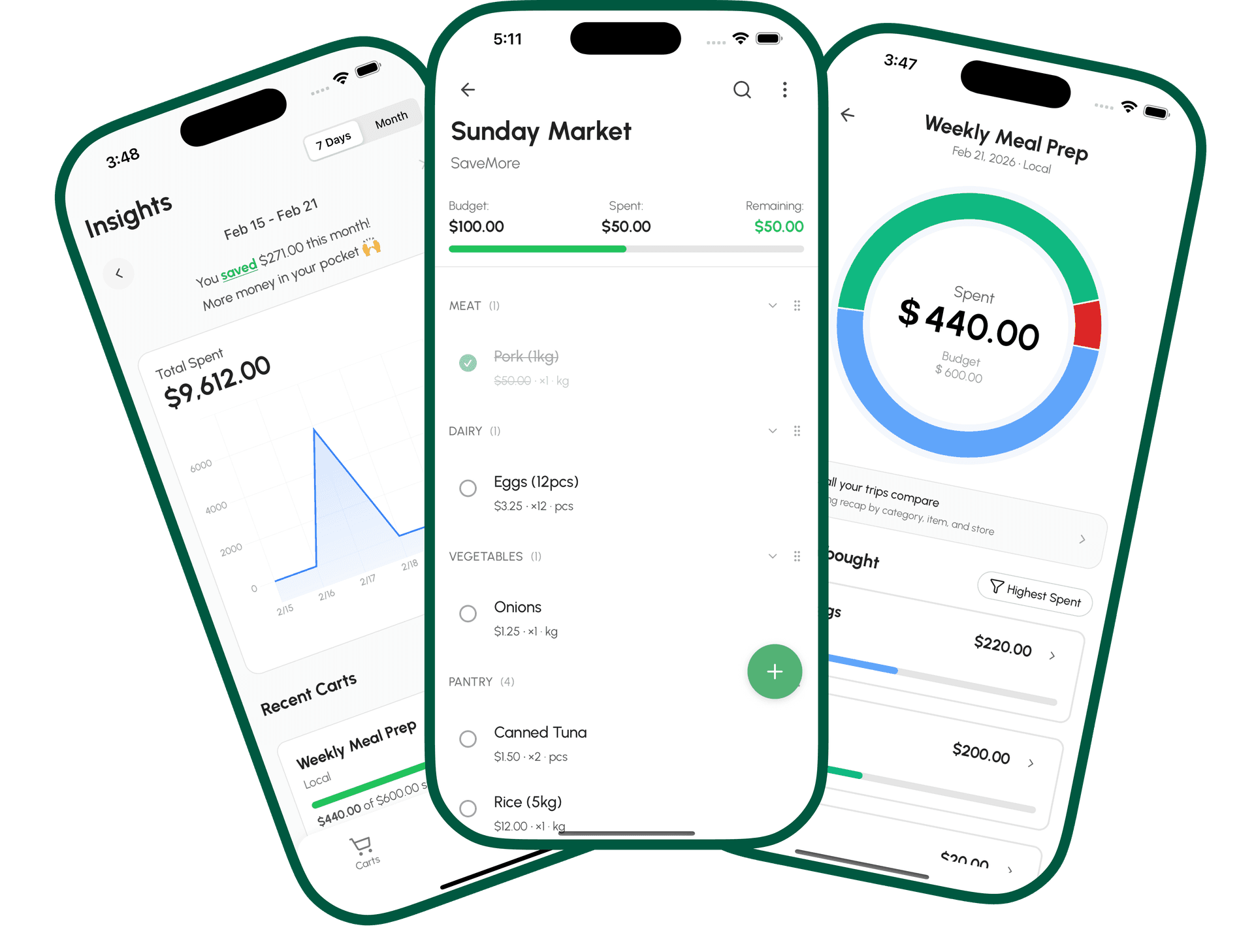
GroceryBudget lets you set a budget per trip, add items with prices as you shop, and see your remaining budget in real time. Price memory means items you buy regularly — eggs, rice, cooking oil — auto-fill from your last purchase price. You don't retype the same prices every week.
For single adults: set up a weekly budget that matches your target, track your first 3–4 trips, and let the Insights tab show you where the money actually goes. Most people discover 1–2 categories where they're consistently overspending without realizing it.
The app is free to start, works offline (useful in markets with poor signal), and supports Philippine pesos.
Download GroceryBudget on iOS or Android. No account needed to start.
---
Also useful: Filipino Family Grocery Budget Guide 2026 — monthly benchmarks by family size. And Palengke vs. Supermarket: What's Actually Cheaper — for where to shop to maximize savings.
Frequently Asked Questions
How much should one person spend on groceries per month in the Philippines?+
Realistically ₱1,500–₱2,500 on a tight budget, with comfortable solo budgets running ₱3,000–₱8,000 depending on how much you cook versus eat out.
Can you eat on ₱3,000 a month in the Philippines?+
Yes, with planning — rice, eggs, canned fish, vegetables, and cheaper proteins like monggo and chicken. It takes palengke shopping and cooking from scratch.
What is the cheapest way to eat as a single person in the Philippines?+
Cook in batches, buy rice and staples in bulk, shop fresh goods at the palengke, and limit convenience-store and delivery spending.