I Tracked Every Grocery Purchase for 90 Days
Ninety days of logging every grocery item, price, and store. The data surfaced four things we were completely wrong about.
Key Takeaways
• Quick trips ('just a few things') accounted for 31% of total grocery spending — and were completely written off in our mental estimate.
• The biggest spending category often isn't what you expect: snacks and convenience foods rivaled meat spending across 90 days.
• Our actual spending was 25% higher than our mental estimate — a gap that only closed when we tracked every cart, including the small ones.
Track your grocery spending as you shop
Free to use. Works offline, no account needed.


When we built GroceryBudget, we tracked our own grocery spending obsessively. That was partly to test the app, and partly because we genuinely wanted to understand what the data would show.
What we found was surprising — not because the patterns were unusual, but because we had been completely wrong about our own spending habits for years.
Here are the four biggest things we learned.
1. Quick Trips Cost More Than Planned Shopping Trips
Before tracking, we thought of our Saturday morning supermarket run as our "grocery budget." That was the trip we planned for. That was the number in our head.
What we didn't account for: every other stop. The Tuesday "I just need milk and bread" run that turned into $34. The Thursday stop for one ingredient that added $22 to the week. The Saturday afternoon drugstore where half the items were snacks.
After 90 days, we added up all the "quick trips" separately. They accounted for 31% of our total grocery spending — and we had mentally written them off as nothing.
The quick trip problem is real for a few reasons. When you go in without a list or a budget, there's no friction against impulse additions. When you're picking up "just a few things," everything else seems like a small extra. And because these trips don't feel like "real" grocery shopping, they don't get counted in your mental estimate of what you spend.
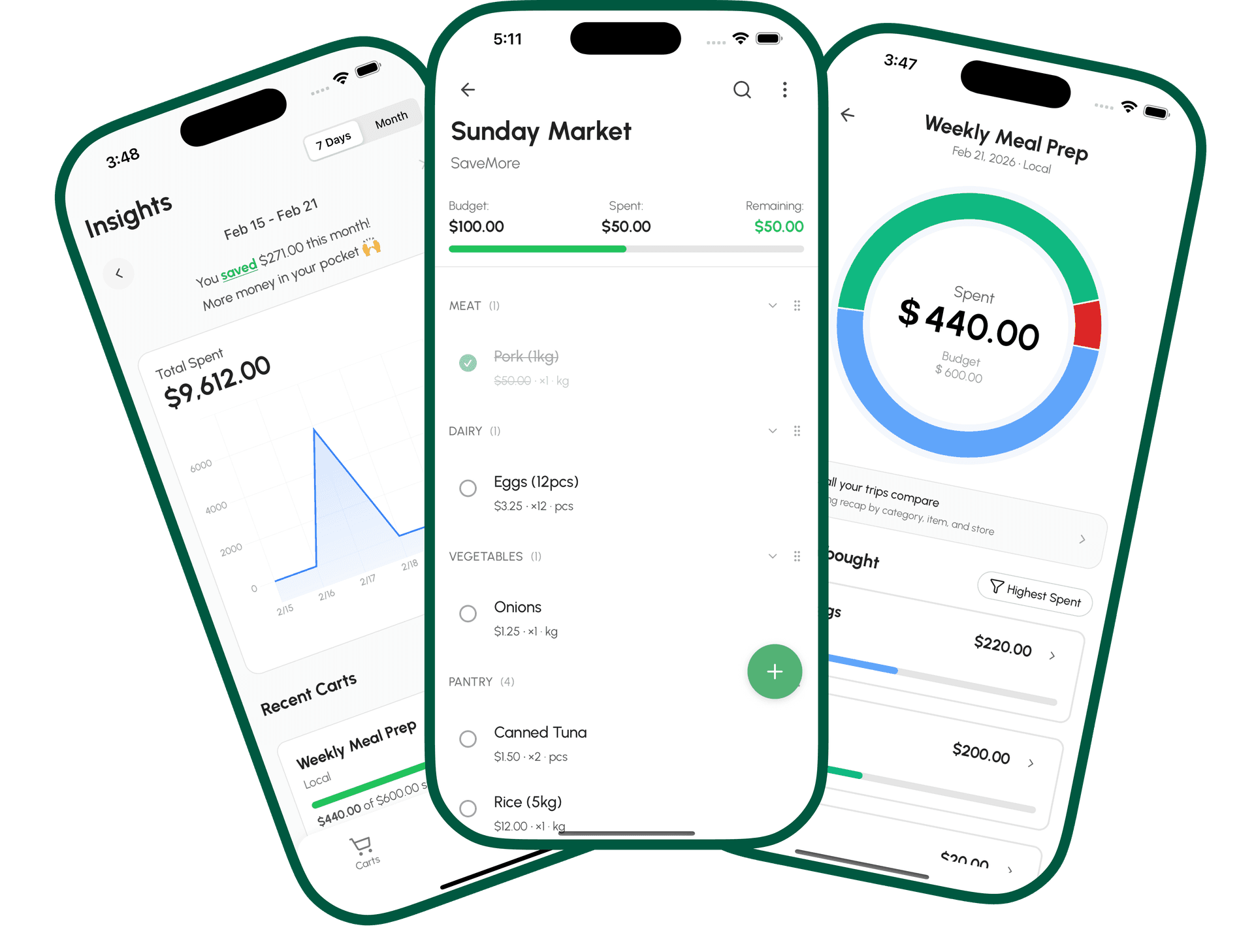
GroceryBudget's spending insights showed us this pattern clearly once we had data from all our carts, including the small ones. We started creating a cart for every trip — even the quick stops — and it immediately made us more deliberate about what we were actually buying.
2. One Category Was Eating Our Budget
We thought our biggest spending category was meat. It's the most expensive item per unit, and we buy it every week. Seemed obvious.
We were wrong. After three months, the category breakdown showed that snacks, drinks, and convenience foods — things we didn't think of as "real" spending — were almost as large as our meat spending combined.
The individual items were cheap. A bag of chips, a bottle of sparkling water, a box of crackers, a prepared dip. None of it seemed significant in the moment. But across 90 days and dozens of shopping trips, it added up to more than we expected.
This is exactly the pattern that tracking reveals and memory conceals. You remember the $18 steak. You forget the six $4 snack purchases that happened alongside it.
The category view in GroceryBudget's spending insights is what made this visible. Once we saw the breakdown — dairy this much, produce this much, snacks and drinks this much — we could make a deliberate choice about whether those proportions matched our actual priorities.
Stop guessing what your groceries cost
Free to use. Works offline, no account needed.
3. Store Loyalty Was Costing Us Money
We had a "regular" store. We'd been shopping there for years. It was familiar, convenient, and we knew the layout. We had a rough sense that it was reasonably priced.
After 90 days of tracking prices, we started comparing. On the dozen or so items we buy every single week, our regular store was more expensive than a discount grocer nearby — consistently, not just on sale weeks. The difference on chicken, eggs, canned goods, and dairy added up to roughly $35-45 per month.
We weren't making a bad choice from ignorance. We just had never had the data to compare. The price memory feature in GroceryBudget records what you pay at each store, so over time you can see actual price history rather than relying on impressions.
We didn't change where we shop entirely. But we shifted two or three of our highest-volume purchases to the cheaper store. That partial change is worth more than the zero change we'd been making for years.
4. Our Actual Spending Was 25% Higher Than Our Mental Estimate
This one is probably the most universal.
Before we started tracking, we thought we spent about $550-600 per month on groceries. That was our best guess — the number we'd give if someone asked.
The real number, averaged across the 90 days: $738 per month.
The gap wasn't one big splurge. It was a consistent pattern of underestimating small purchases, forgetting quick trips, and not accounting for everything food-related that we bought. Household staples from Target, a grab-and-go lunch here, a coffee and snack there. None of it showed up in our mental model of our grocery spending.
This gap between perceived spending and actual spending is almost universal. We've heard the same story from people who've started tracking with GroceryBudget: "I thought we spent X. We actually spend X plus 20-30%."
The uncomfortable part is that you can't fix a problem you don't know you have. If you think you're spending $550, you're managing a $550 budget. You're actually spending $738 and calling it a success every month.
What Changed After 90 Days
We didn't cut our grocery spending in half or do anything dramatic. But knowing the real numbers changed how we made decisions.
We started treating every trip as a cart worth tracking, not just the main shopping run. We shifted a few high-volume purchases to the cheaper store. We made a conscious choice to reduce the snack category rather than just letting it happen by default. And we stopped using a mental estimate of our grocery spending, because we now knew the mental estimate was wrong.
The 25% gap we closed worked out to about $185/month — not from following a complicated system, but just from having accurate information.
Tracking doesn't automatically save money. But it gives you the data to see where your money is going, which is the only way to decide if you're spending it the way you want to be.
If you haven't tracked your grocery spending, start with your next trip. Create a cart, add items as you shop, and do it for every trip for a month. You'll learn something about your own habits that surprises you — and that's where the real savings come from.