Grocery Budget for a Family of 4 Per Week (2026)
Most family-of-4 guides give you a monthly number and stop there. A weekly breakdown at three spending levels, and where families consistently overspend.
Key Takeaways
• USDA moderate-cost plan for a family of 4 translates to roughly $310–$345/week — most families spend more without realizing it.
• Weekly budgeting is more actionable than monthly — a $125/trip limit is easier to hit than a '$500/month' goal you can't see at the store.
• The three places family-of-4 households consistently leak budget: protein choices, snack and beverage spending, and mid-week convenience runs.
Put this advice to work on your next grocery trip
Plan your list, set a budget, and track the total while you shop.
Explore GroceryBudget features →

Most people think about grocery budgets in months. But buying decisions happen by the trip. If you go to the store twice a week, your monthly budget is really four shopping trips worth of decisions — and most of that budget is won or lost while you're in the store, not when you're planning it.
Here's how to think about a family-of-4 grocery budget at the weekly level, what each tier actually buys you, and where families consistently lose money without realizing it.
What the USDA Data Says for a Family of 4
The USDA food plans are the most reliable public benchmark for U.S. household food costs. For a family of four (two adults 19–50, two school-age children) in 2026:
| Plan | Monthly | Weekly (÷4.3) |
|---|---|---|
| Thrifty | $820–$900 | $191–$209 |
| Low-Cost | $1,090–$1,200 | $254–$279 |
| Moderate-Cost | $1,350–$1,490 | $314–$347 |
| Liberal | $1,630–$1,800 | $379–$419 |
The Moderate-Cost Plan is where most middle-income four-person households land when they're cooking regularly and being reasonably intentional about spending. That translates to roughly $310–$350/week.
The Thrifty Plan ($190–$210/week) is achievable but requires consistent meal planning, minimal food waste, and nearly all meals cooked from scratch. Hard to sustain without real discipline.
What Each Weekly Budget Level Gets You
Under $200/week (Thrifty)
This is possible, but it requires structure. At this level:
- Protein: Mostly chicken thighs, eggs, canned tuna, dried beans, and ground beef (not steak, not fish fillets every week)
- Produce: Seasonal and on sale — whatever's cheap that week, not whatever looks good
- Grains: Store-brand bread, rice, and pasta in bulk
- Dairy: Milk, cheese, butter — stick to store brands
- Snacks: Minimal. Popcorn, apples, peanut butter. The chip budget is the first thing to cut.
This is nutritionally sound but requires real meal planning. A family that shops without a list and a plan won't stay under $200/week for more than a trip or two.
$250–$350/week (Low-Cost to Moderate)
This is the realistic range for most families who cook most nights but don't obsess over every price.
- Protein: More variety — ground beef, chicken breasts and thighs, occasional pork or fish
- Produce: More latitude. Fresh vegetables without strict seasonality constraints. Some fruit beyond just apples and bananas.
- Convenience: A little. Pre-cut vegetables occasionally. Rotisserie chicken once in a while. Some frozen meals for busy nights.
- Dairy and extras: Greek yogurt, some specialty cheeses, a wider range of snacks for the kids.
- Brand flexibility: Store brands for most things, name brands when it matters to your household.
This is a comfortable range for most families. You don't feel deprived, but you're not ignoring prices either.
$380–$450/week (Liberal and above)
At this level, food quality becomes the priority over cost. Premium proteins, organic produce, specialty items, significant convenience foods. Not unreasonable, but usually the result of habits rather than intentional choice — many families spending here don't realize they're doing it until they track it.
Put this advice to work on your next grocery trip
Plan your list, set a budget, and track the total while you shop.
Explore GroceryBudget features →Where the Budget Leaks
1. Protein is where most of the variance is
The price difference between grocery strategies shows up most clearly in how you buy meat:
| Choice | Approximate Cost | Weekly Impact (4 people) |
|---|---|---|
| Chicken thighs (bone-in) | $1.29–$1.79/lb | Low |
| Chicken breasts (boneless) | $2.99–$4.99/lb | Moderate |
| 80/20 ground beef | $3.99–$4.99/lb | Moderate |
| Ribeye or NY strip | $10–$20+/lb | High |
| Salmon fillet | $8–$14/lb | High |
A family eating chicken thighs and ground beef three nights a week will spend $40–$60 less per week on protein than one eating chicken breasts and salmon. Over a month, that's $160–$240.
2. Snacks and beverages are invisible line items
Chips, crackers, granola bars, juice boxes, sparkling water, soda — these feel small per item and rarely make it onto the grocery list as a category. But for a family of four, snack and beverage spending typically runs $60–$120/week without anyone noticing.
Quick check: look at your last three receipts and add up anything that wasn't a meal ingredient. For most families, this number is surprising.
3. Mid-week convenience runs cost more per item
The planned weekly shop is where you're most price-conscious. The Tuesday "quick run" to grab a few things is where you're least conscious. Studies consistently show that unplanned, small trips have a significantly higher per-item cost than planned shops — partly because you're buying premium items (the nice cheese, the pre-cut fruit) and partly because you rarely leave with just what you came for.
Two major shops a week is almost always cheaper than one big shop plus multiple small fill-ins.
Setting a Useful Weekly Budget
A monthly budget is too abstract to use in the store. A weekly number is more actionable — but a per-trip number is what actually works.
Step 1: Start with your weekly target. If you're aiming for the Moderate range, that's roughly $325/week.
Step 2: Divide by your number of shopping trips. If you shop twice a week, that's about $160 per trip.
Step 3: Set a budget in the app before you leave. When you have a $160 number and you see the running total in real time, you make different decisions than when you're shopping blind.
Step 4: Track for four weeks. Your first tracked month will probably show you're 15–25% over where you want to be. That data tells you which categories are running high. It's easier to cut a specific category than to "spend less generally."
Using GroceryBudget for Family-of-4 Tracking
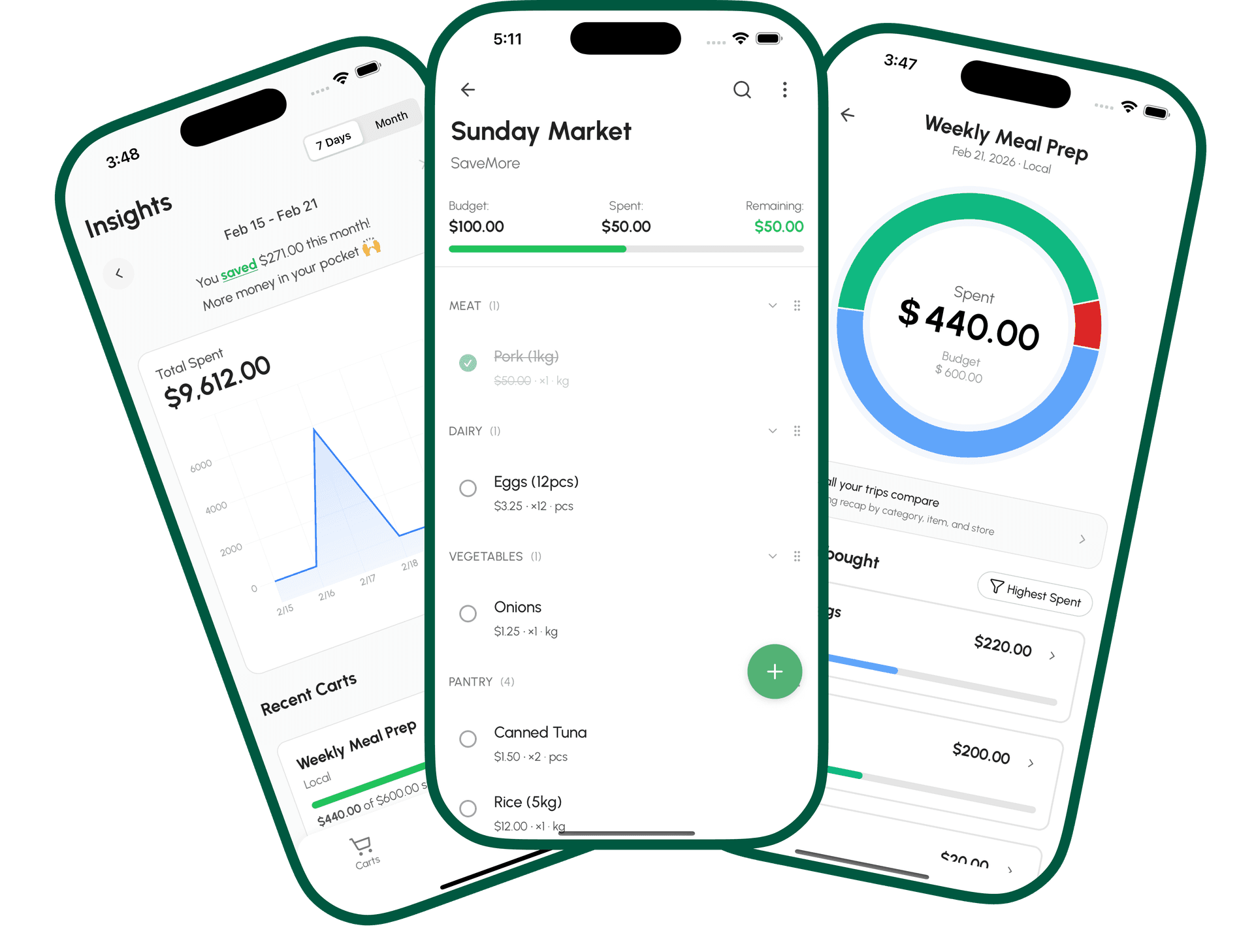
GroceryBudget lets you set a budget per trip and see your running total in real time as you add items. Price memory means your regular items — chicken, eggs, bread, milk — auto-fill from your last purchase price, so adding 20 items takes under a minute.
For a family of four where multiple people shop: Family Sharing (Premium) lets both partners contribute to the same cart from separate phones. If one person grabs a few things mid-week, the other can see the running total before doing the main shop.
Download GroceryBudget on iOS or Android — free to start, no account needed.
Want to skip building the cart from scratch? Open this moderate-cost weekly grocery list — it loads directly into GroceryBudget with 20 items already on it, based on the USDA numbers above.
---
Related: How much to spend on groceries per month in 2026 — USDA benchmarks for every household size. Average grocery cost for a family of 3 — three-person household benchmarks and where the money goes. And grocery budget by income — percentage-based targets by salary level.