Trader Joe's vs Whole Foods: Which Is Cheaper in 2026?
Trader Joe's runs roughly 30% cheaper on overlapping items, and Prime discounts don't close the gap. Here's the item-by-item breakdown and where Whole Foods still wins.
Key Takeaways
• Trader Joe's runs roughly 30% cheaper on comparable items, driven by an almost entirely private-label range.
• Prime member discounts narrow the gap at Whole Foods but do not close it on a full basket.
• Whole Foods wins on fresh selection, butcher and seafood counters, bulk bins, and specialty diets Trader Joe's simply doesn't stock.
Compare stores using your own grocery history
Remember the prices you paid and see which store is cheaper for the items you buy.
See price history and store comparison →

Trader Joe's and Whole Foods both attract the shopper who cares about food quality, but they solve that problem in opposite ways. Whole Foods gives you an enormous curated selection at a premium. Trader Joe's gives you one option per category at a discount.
The price question has a clear answer here, unlike most store comparisons. The more useful question is what the cheaper option costs you in selection.
The Overlapping Basket
| Item | Trader Joe's | Whole Foods |
|---|---|---|
| Whole milk, 1 gallon | $3.49–$3.89 | $4.29–$4.99 |
| Eggs, 1 dozen (large, cage-free) | $3.49–$3.99 | $4.49–$5.49 |
| Bread, sandwich loaf | $2.99–$3.99 | $3.99–$5.49 |
| Bananas | $0.29 each (~$0.87/lb) | $0.69–$0.79/lb |
| Chicken breast, boneless, per lb | $5.99–$6.99 | $7.99–$9.99 |
| Ground beef 85/15, per lb | $5.99–$6.99 | $7.49–$8.99 |
| Almond butter, 16oz | $5.99–$6.99 | $8.99–$11.99 |
| Pasta, 16oz box | $0.99–$1.49 | $1.99–$2.99 |
| Olive oil, 500ml | $5.99–$7.99 | $8.99–$13.99 |
| Frozen pizza | $4.99–$5.99 | $6.99–$8.99 |
Typical 2026 ranges. Whole Foods pricing varies more by region than Trader Joe's does.
Total the nine per-unit-comparable rows and Trader Joe's comes out roughly 30% ahead ($44 vs $64 at midpoints). The gap is widest on pantry goods where brand premium is largest (olive oil, nut butters, pasta) and narrowest on commodity items.
Bananas are the one row that goes the other way. Trader Joe's prices them per banana rather than per pound, and at roughly three to a pound that works out dearer than Whole Foods.
Trader Joe's bananas deserve a note: a flat 29 cents each, unchanged for years, and famously not priced by weight.
Does Prime Close the Gap?
Amazon Prime members get 10% off sale items at Whole Foods plus rotating member-only deals, weighted toward produce and meat.
It helps. It does not close a roughly 30% gap. To break even you would need to buy almost exclusively discounted sale items, which is not how most people shop. If you are already paying for Prime for other reasons, treat it as a discount on a still-more-expensive store.
Compare stores using your own grocery history
Remember the prices you paid and see which store is cheaper for the items you buy.
See price history and store comparison →What the Savings Cost You
This is the honest tradeoff, and it is why plenty of people shop both.
Selection. Trader Joe's stocks roughly 4,000 SKUs. Whole Foods carries tens of thousands. Trader Joe's has one olive oil in your price range; Whole Foods has fifteen.
Fresh counters. Whole Foods has real butcher and seafood counters where you can request specific cuts. Trader Joe's sells pre-packaged only.
Bulk bins. Whole Foods has them, and for grains, nuts, and spices they are frequently cheaper per ounce than Trader Joe's packaged equivalent.
Specialty diets. If you need specific allergen-free, keto, or medical-diet products, Whole Foods carries depth that Trader Joe's does not attempt.
Produce consistency. Trader Joe's produce is mostly pre-packaged in fixed quantities, which drives waste for small households. Whole Foods sells loose, so you buy three apples instead of a bag of six.
The Split Most People Land On
- Trader Joe's for the staples run — pantry, frozen, dairy, snacks, and the private-label items that make up the bulk of a basket.
- Whole Foods for what Trader Joe's can't do — specific cuts from the butcher, bulk bins, loose produce, specialty diet items.
- Watch the Trader Joe's basket creep. The store is engineered for discovery, and the seasonal end caps are effective. A trip for twelve items that leaves with twenty-two is the normal outcome, and it erases the per-item savings.
That last point is the one people underestimate. Trader Joe's being cheap per item does not make a Trader Joe's trip cheap.
Track What You Actually Spend at Each
Store-level averages will not tell you your number. A household buying mostly pantry goods captures the full 25%. One buying mostly fresh meat and loose produce captures much less, and may genuinely be better off at Whole Foods for the quality.
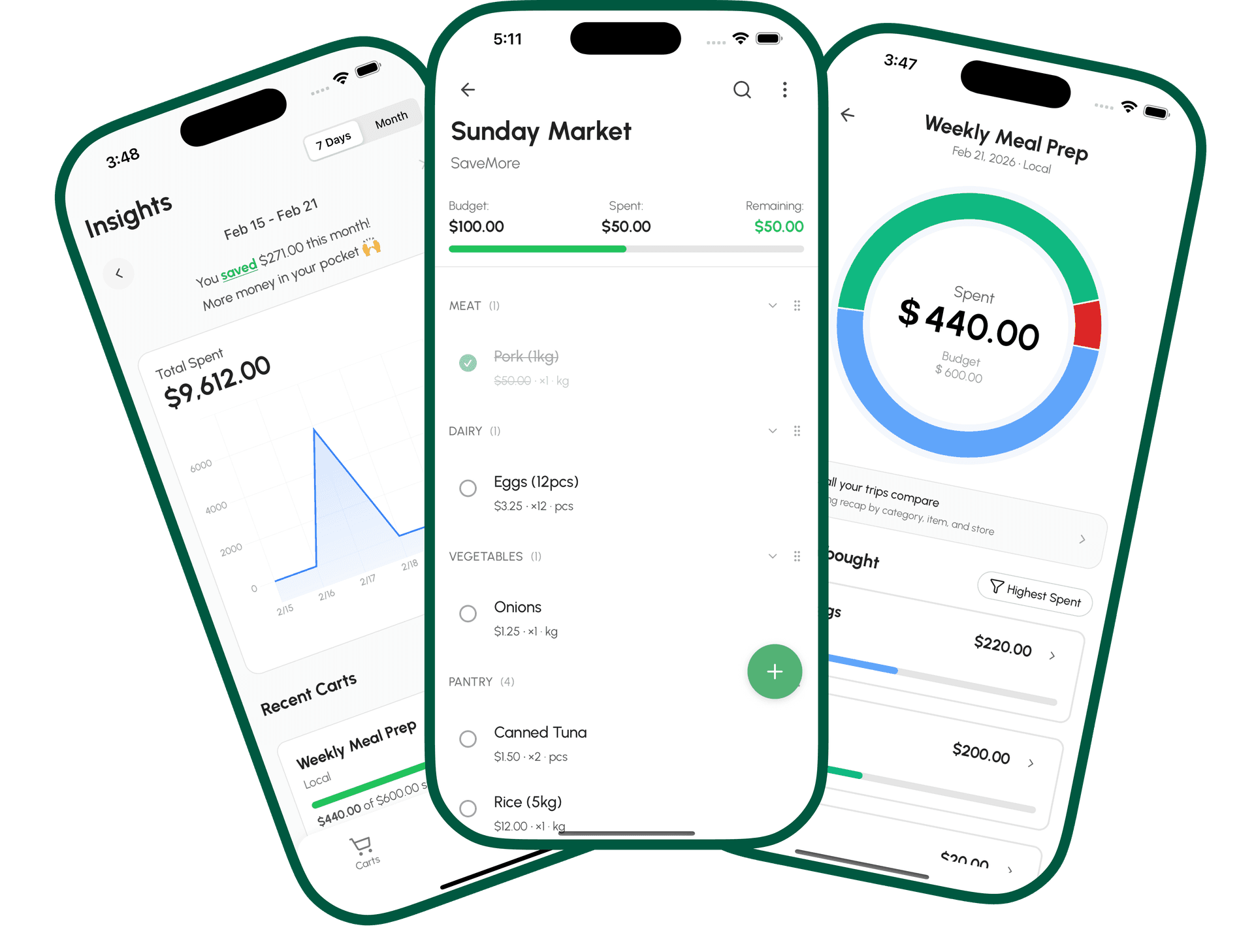
GroceryBudget records what you paid for each item at each store and shows you where your money actually goes further, based on what you actually buy. It also tracks your running total against your budget while you shop, which is the part that catches basket creep before checkout does.
Works offline, free to start, no account required.
Download GroceryBudget — free, offline, tracks your total as you shop.
Also available on Android: Google Play.
---
More US price comparisons: Walmart vs Aldi · Walmart vs Kroger · Aldi vs Lidl · Target vs Walmart · Costco vs Sam's Club
Frequently Asked Questions
Is Trader Joe's cheaper than Whole Foods?+
Yes, consistently. On comparable items Trader Joe's runs roughly 30 percent cheaper. The reason is structural: around 80 to 90 percent of what Trader Joe's sells is its own label, which strips out brand marketing costs, and it carries a deliberately limited selection that keeps buying volume concentrated.
Does Amazon Prime make Whole Foods cheaper than Trader Joe's?+
It narrows the gap but does not close it. Prime members get 10 percent off sale items plus rotating member deals, which helps most on produce and meat specials. A 10 percent discount does not overcome a roughly 30 percent baseline gap on a full basket.
Why is Trader Joe's so much cheaper?+
Three reasons: nearly everything is private label, the selection is deliberately small so buying volume is concentrated into fewer SKUs, and stores are compact with low overhead. It also runs almost no traditional advertising.
What does Whole Foods do better than Trader Joe's?+
Fresh selection and specialty range. Whole Foods has full butcher and seafood counters, bulk bins, a much wider organic produce assortment, and depth in specialty diets like keto, gluten-free, and allergen-specific items. Trader Joe's carries one option per category, if it carries the category at all.